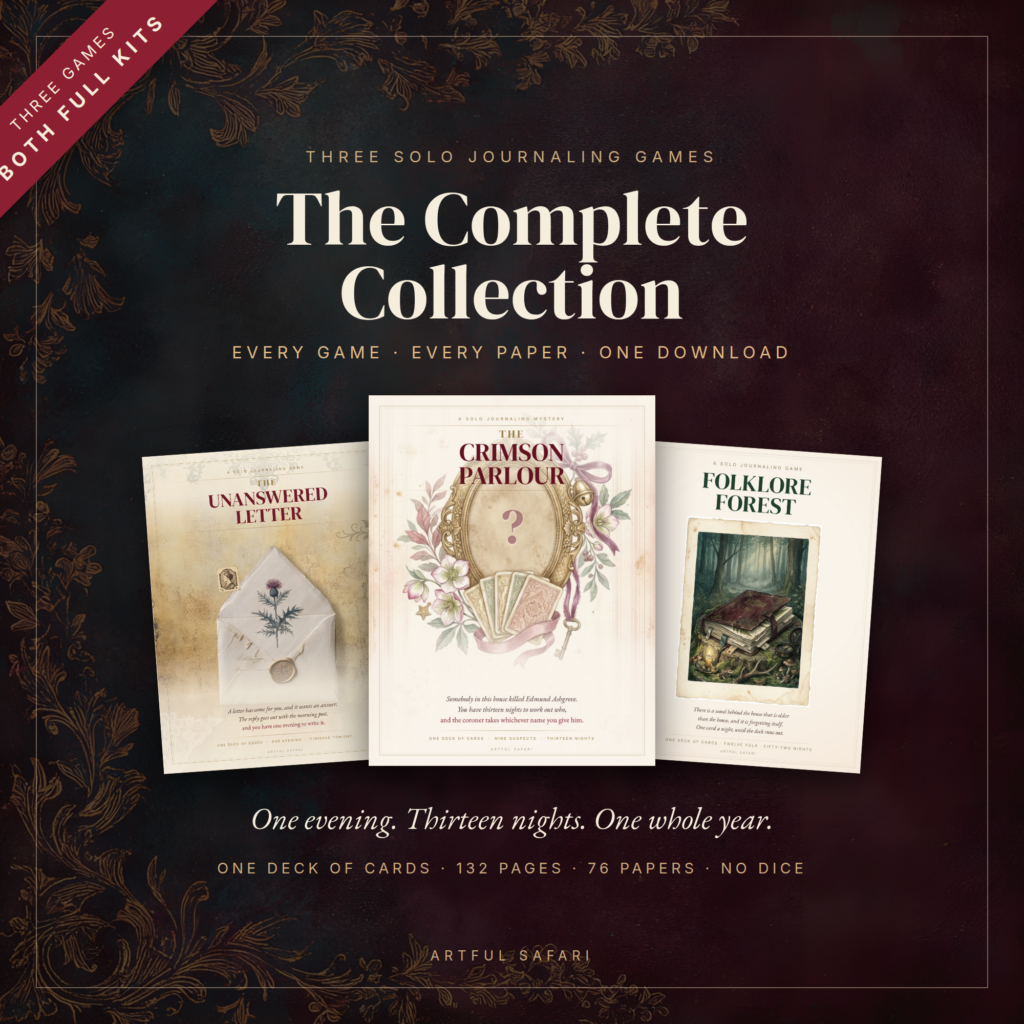


A solo journaling game for keeping a commonplace book, drawn in one style so every page of it sits together.
Catch a line. Turn a card. Write it down.
The Commonplace Hours is a solo journaling game played with a notebook you already own and one ordinary deck of cards. You write down lines other people said. The card you turn decides how the line goes on the page and where the next one comes from.

A commonplace book is four hundred years old. It holds what struck you, in the words the other person used, rather than what happened to you. Milton kept one. So did Darwin. This game hands you the practice and the machinery on the same night you buy it.
How one entry works

1 · Catch a line
Something somebody said, something on a sign, a sentence off a page. You copy it by hand exactly as it came, and you write down who said it.

2 · Turn one card
The suit says what to do with the line: copy it plain, hold it back for the end of the book, answer it in your own words, or join it to an entry you already kept.

3 · Write one word in the margin
That word is the head, and it says what the line is about to you. It goes in the index at the back. When a head comes round a second time you write the new page number beside the old one, and the two entries now sit under the same word.
What players and buyers say
Real customer words, with the product they refer to named plainly.
★★★★★
“Really liking this game. Very creative.”
Jennifer · on Folklore Forest, another Artful Safari game
★★★★★
“A great trigger for a fun new interactive art journal.”
Sharon · on Folklore Forest, another Artful Safari game
★★★★★
“Love the designs and quality!”
Ashlee · on another kit in the Artful Safari shop
Thirteen places to find the next line
The rank of the card you turned sends you somewhere for the next one. Something overheard. Words put up for strangers to read. A line you think is wrong. The youngest person you spoke to this week.
They work as journaling prompts if that is what you want from the book. The difference from a prompt book is that they send you out to find a line somebody really said instead of asking you to invent one, so the page fills with other people rather than with you.
All thirteen are free and none of them needs you to go anywhere special.
An entry costs a pen.
Every seventh entry is an Hour
There are eleven Hours and they run in order. An Hour never asks for a new line. It sends you back through the ones you already kept.
Find the entry you have repeated out loud to somebody. Copy one line onto something that leaves the house. Read the whole book through as though a stranger kept it. By the eleventh Hour you copy the index onto the first page, and that list of about twelve words in your own handwriting is the finished object.
Nothing is due on a date. An entry happens when you catch a line, so there is no streak to break. Stop in March and the lines you kept are still a finished thing.
A page out of the book

Three entries are written out in full so you can see how much is enough before you write your own: the line, who said it, what the card asked for, and the head in the margin.
Every line quoted in the book is a real line a real person said or wrote. None of it was invented to fill a page.
What you download

20-page book
The premise, both tables, the eleven Hours, the closing, three worked entries, and a diagram on page two you can play from tonight without reading the rest.
Three printable sheets
The reference card, the index, and the Hours record with its tally. All three are kept and written on. None of them is used up, so you never run out of anything.
Printer-friendly copies
Both files again with the page wash taken out, so your printer is not spending its ink on decoration.
No papers, on purpose
This is the game on its own. You play it with a pen, a deck of cards and a notebook that is already in the house.
Four print-ready PDFs · US Letter, A4 compatible · 300 DPI · about 21 MB · print as often as you like for your own journaling
What it looks like
Dark academia, and not by accident: night skies, moths, a lantern, and a moon that turns through the eleven Hours. It is a bookish thing you leave open on the table rather than shut in a drawer, and the ones you can see are the ones you keep up.
Nothing is scored. There is no board, no app and no other player, and you are never asked to make anything up or to be anybody.
Nothing in it uses anything up
Every line is copied out by hand and the card goes back in the deck. No instruction asks you to cut up a book, tear out a page or glue down something you own. The three printable sheets are written on and kept, and you can print them again whenever you want.
John Locke published the indexing method in 1706, and it is why a book kept this way can show you something you did not already know: the heads collect entries you wrote far apart, and you read them together.
Will this work for me?
I have never played a tabletop or journaling game. Can I do this?
Yes. There is a diagram on page two you can play from tonight, and three real entries are written out in full so you can see how much is enough.
Do I need dice or anything special?
No. One ordinary deck of playing cards and a notebook you already own.
How long does an entry take?
There is no fixed length. You play at your own pace: a turn a day or a turn a week is up to you. An Hour sends you back through the lines you already kept, and there are only eleven of them across the whole book.
Is this the same as a book of journal prompts?
No. A prompt asks you to invent something. This sends you to find a line somebody really said, and then tells you what to do with it and where to file it.
What if I stop for a while?
Nothing is due. An entry happens when you catch a line, never on a date.
Do I have to be a writer?
No. You are copying other people’s words down.
Is this a physical product?
No. It is an instant digital download. Nothing will be posted.
How do I print it if my journal is A5?
Everything is US Letter portrait and prints on A4 without trouble. Print at 100 per cent rather than “fit to page”, and for A5 use 2 pages per sheet in your printer dialog rather than folding a sheet in half. A folded portrait sheet gives you a landscape half and it prints sideways.
What you receive
Four high-resolution PDFs, delivered as an instant digital download the moment you pay. The game is for personal and small-business use; please do not share, redistribute or resell the files themselves.