
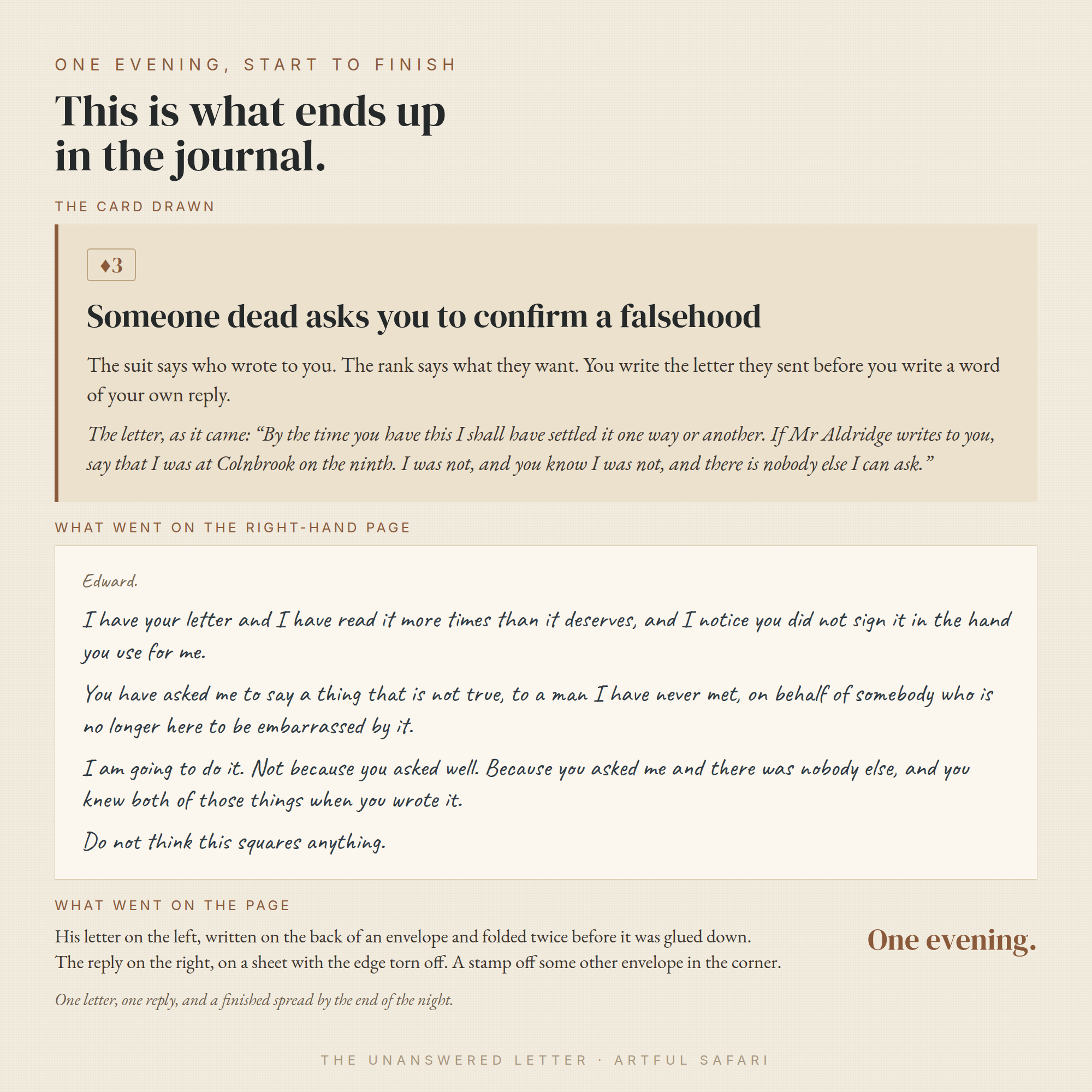
An RPJ is a role playing journal: a solo journaling game you play on your own in a notebook, working through printed prompts and answering them as a character whose story you are writing down. The word was coined on camera in July 2026 by the YouTuber Journals4breakfast, and it spread across craft YouTube in about five weeks.
The word is new. The thing it names is not, and the same five questions come up every time somebody meets an RPJ for the first time.
Table of Contents
1. What an RPJ actually is
You buy a small printable book. It holds a setting, a handful of tables and a run of prompts, and you answer those prompts in a journal you already own.
You are the only player. Nobody is waiting on you, nobody scores you, and there is no evening in the diary you have to keep free. A card or a die decides the things you would otherwise have to invent, so the story surprises you as you write it.
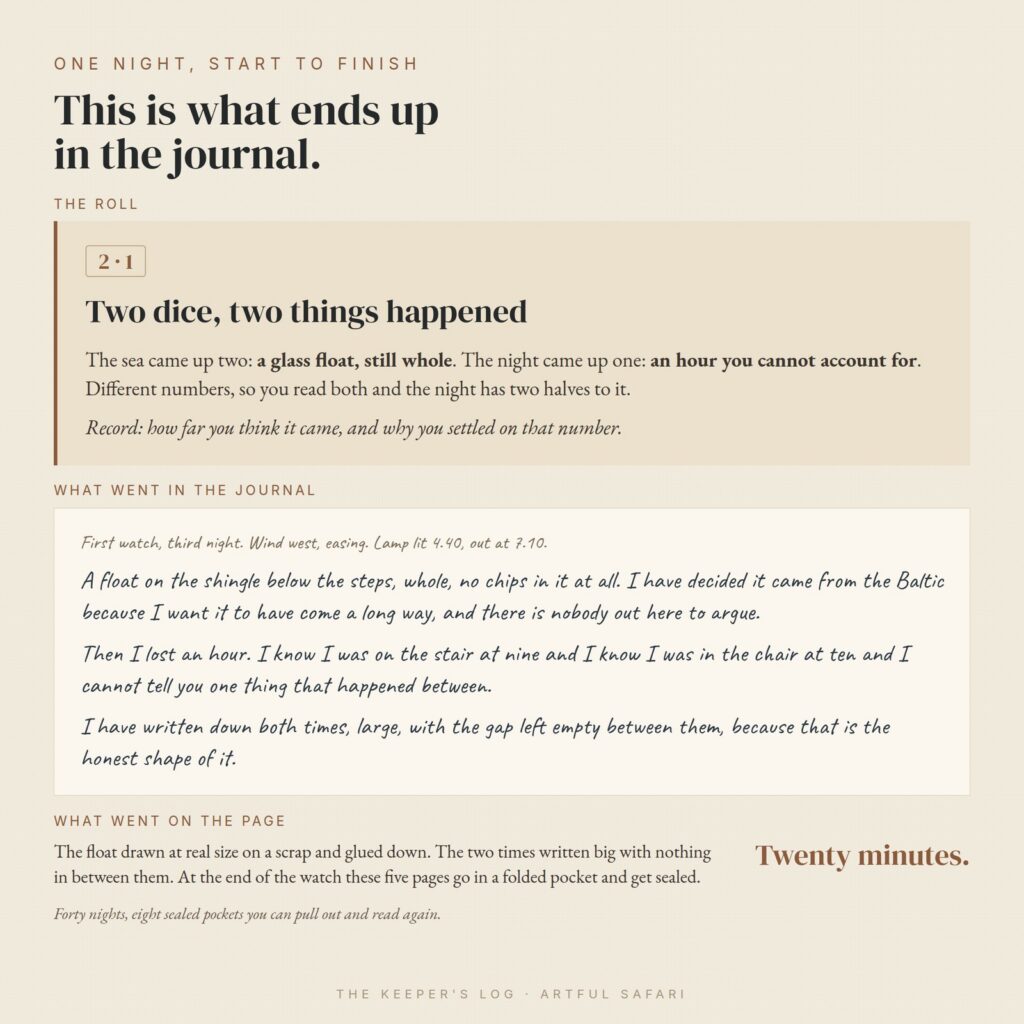
The plain-English name for the category is solo journaling game, and that is the phrase most people type into a search box. RPJ is the shorter word the community made for itself. Both mean the same thing.
What ends up in the book looks like craft rather than homework. Pressed paper, stamped edges, a map, a taped-in letter, and somewhere in the middle a few lines of writing that move the story on.
2. Where the word RPJ came from
It was coined by Journals4breakfast in her July 2026 video about falling into the hobby, which has since passed 25,000 views. If you watch one thing before reading on, watch this. The renaming happens partway through, mid-sentence, because the four-word name for it had worn her patience out:
“That is too many words for me. We’re going to just call these RPJs, roleplaying journals. Deal. Deal.”
Journals4breakfast, 18 July 2026
She added a line to that video’s description the same day: “from this moment on… to be known as RPJ’s”. It stuck faster than anyone expected.
Five weeks later the word appears in four video titles across two channels, in nine of the thirteen descriptions across three channels, and in comments from 32 separate viewers who are not any of those creators. The HalFass Crafter put it straight in an episode title, which is the clearest sign a word has crossed from one channel to another:
Credit where it belongs. Andrea at Journals4breakfast named this and the rest of us borrowed it.
3. How an RPJ differs from the journaling you already do
A junk journal or an art journal holds your life. An RPJ holds someone else’s, and you find out what happens to them at the same speed the page does.

That difference solves a specific problem. Plenty of people own beautiful books they cannot fill, because a blank page asking for your own week is a hard thing to answer on a Tuesday. A prompt about a locked door in a house you have never been to is much easier.
It also gives the supplies a job. The stash in the cupboard becomes props for a story instead of stock waiting for the right occasion. Journals4breakfast calls that part, shopping her own stash for an RPJ, her favourite thing about the whole hobby.
If you are new to the craft side of it, our guide to what a junk journal is covers the book itself.
4. How an RPJ differs from a game round a table
This is the question behind the flinch. Role playing games have a reputation for thick rulebooks, a table of people and someone running the whole thing, and none of that applies here.
You play alone, at your own pace, and nothing has to be said out loud. You read a prompt, decide what your character does, and write it down. If a game asks you to settle something by chance, a die or a shuffled deck answers it for you.
The rules in a solo journaling game usually run to two or three pages and most of the book is prompts. You can put it down for a fortnight and pick it up with nothing lost. Longer walkthrough here: a full evening of a solo journaling game, start to finish.
5. What you need to start an RPJ
A book, a printed game and something to write with. That is the floor, and almost everyone reading this already owns two of the three.
- A notebook. Any bound book. Some people cut up an old hardback and glue their pages into it.
- A printed game. Print it single-sided and clip it, or read it off a screen beside you.
- A randomiser. A six-sided die, or the ace to six from a pack of cards, or a deck you already read with.
- Your stash. Optional and the whole point. Scraps, stamps, tape, whatever is in the drawer.
There are plenty of free games to try before you spend anything. Shannon Green prints twelve of them as booklets in this one, and the printer settings she lands on are the part worth stealing:
itch.io’s journaling tag lists hundreds more, a lot of them pay-what-you-want.
Take your time over the setup. People in this hobby routinely spend a fortnight building the book before they draw a single card, and they count that fortnight as playing.
Where the RPJ crowd gathers
Right now it is mostly YouTube comment sections. Shannon Green and the two channels above carry the bulk of it, and the comments under them are full of people asking each other beginner questions and getting kind answers back.
There is also a Discord server, RPJourneys, started by Journals4breakfast in July 2026 and running at 149 members when we checked on 24 August. It is a show-and-tell room for finished pages. We have not linked it here because the published invite codes keep expiring, so the working one is whichever a creator has posted most recently in a video description.
If you want the reading list version instead, our seven quiet nights guide is the slow way in.
RPJ questions people actually ask
I’ve printed a game and I have a journal. How do I actually start?
Open to the first page and answer prompt one, badly. The stall is nearly always about wanting the first page to be good, and the fix is to write four sentences and glue something down. Set the book up afterwards, once you know what the story is about. This is the most common sticking point in the whole hobby, so you are in a large and well-decorated queue.
Do I need dice?
No. Take the ace to six out of a pack of playing cards, shuffle them and turn one over whenever the game says to roll. Our own card games are designed for a standard 52-card deck of playing cards. Plenty of players do buy dice as a small ceremony of starting, which is a fine reason.
Do I have to be a good writer?
No, and most people doing this would not call themselves writers. A typical entry is a few lines, sometimes a list, sometimes a letter your character never sent. One creator filled most of a journal using watercolours, stickers and stamping with barely a paragraph in it. The prompt is doing the difficult part.
I’ve never played a role playing game in my life. Is that a problem?
Not at all, and a good half of this community arrived the same way. Nothing in an RPJ needs prior knowledge of tables, characters or rules. If a term in a game’s booklet loses you, skip it and keep writing. The one thing that reliably makes it click is watching somebody play a session on camera before you start your own.
Which game should I start with?
Start with a setting you would happily decorate for a month, because that matters more than the rules do. Witch, apothecary, lighthouse keeper, cartographer, whatever makes you want to open the drawer. Short games are kinder for a first attempt than long campaigns. If you cannot choose, pick the one whose cover you like and keep the other tab open.
Starting tonight
An RPJ is cheap to try. If you want one evening to find out whether any of this is for you, The Unanswered Letter is a one-sitting game about a letter that was never answered, and it will tell you in an hour or two whether you want the next one.