
A commonplace book is a notebook where you copy out lines worth keeping: something you read, something you overheard, a sentence off a sign. You write down who said it, and you file it by what it’s about to you rather than by the date. People have kept them for centuries, and you can start a commonplace book tonight in a notebook you already own.
This guide covers what goes in one, how it differs from a journal, and the bit most guides skip: how to find an entry again months later.
Table of Contents
What a commonplace book is
A commonplace book is a personal collection of other people’s words. You copy each line by hand, exactly as it came, and add who said or wrote it. Then you give it a heading, one word for what the line is about to you.
That heading is what makes it work. Lines on the same subject end up together, even when you wrote them far apart. There are no rules about what counts, and no need to fill a page a day.
Commonplace book vs journal vs diary
A diary is about what happened to you. A journal is usually about what you think and feel. A commonplace book is about what struck you, in the words the other person used.
You can still add your own reply under a line, and many people do. But the heart of the book is the borrowed line, not your day. If you want a wider look at the different kinds, our guide to types of journaling sets them side by side.
A short history: Locke’s commonplace book index
Commonplace books are old, and the most useful thing to come out of their history is an indexing method.
The philosopher John Locke described his method in a letter to his friend Nicolas Toinard in 1685. It was published in French in 1686, in the journal Bibliothèque universelle et historique. The English translation, A New Method of Making Common-Place-Books, came out in London in 1706, after Locke’s death (Wellcome Collection catalogue record).
His idea was simple. Every entry gets a “head”, a key word for what it’s about. You keep a short index at the front of the book, and you look up a head by its first letter and the first vowel after it.
His own example is the head Epistle: you look under E and I. Two pages of index can then point you to everything in the book, however thick it gets. You can read the 1706 English edition yourself in the Internet Archive scan.
You don’t need his letter-and-vowel grid to use the idea. The part worth keeping is this: one head word per entry, and an index that collects them.
What to put in a commonplace book
Anything somebody really said or wrote. A few kinds of entry to get you started:
- An overheard line. Something said at the shops, on the phone, at dinner.
- A sentence from a book. The one you read twice.
- Words on a sign. Notices, labels, a handwritten note in a window.
- A line you think is wrong. Disagreeing with it is a good reason to keep it.
- Your reply to a line. Copy the line, then answer it underneath in your own words.
- A list. Several short lines on one subject, gathered on one page.
The common thread is that it really was said by someone. If you’d rather work from prompts than found lines, our junk journal prompts are a better fit for that kind of page.
How to start a commonplace book in 4 simple steps
You don’t need a special notebook. Any notebook with pages you can number will do.
- Number the pages. Do it before you start, or as you go. The index only works if every page has a number.
- Leave space for the index. A few blank pages at the front or back. Locke put his at the front; the back works just as well.
- Set out each entry the same way. The line, copied exactly. Who said it (a name, or “a woman at the bus stop”). And a head word in the margin.
- Pick the head word for what the line means to you. Not what it’s literally about. A line about rain might sit under patience.
If you like printed pages pasted into your notebook, our guide to printing junk journal papers at the right size covers fitting a letter-size sheet into an A5 book. If you prefer a whole page of quote and decoration, see how to put a quote on a journal page.
The commonplace book index: how heads collect entries
This is the step that turns a pile of quotes into a book you can use.
- Write the head word in the margin of the entry.
- Turn to your index pages and write the head word there with the page number.
- When the same head comes round again, add the new page number beside the old one.
Now patience might point to page 4 and page 31. Read those two entries together and you’ll often see something you didn’t notice when you wrote either one. That is Locke’s point: the heads collect entries written far apart, so you can read them side by side.
Over time a handful of heads come up again and again. That short list, in your handwriting, ends up saying a lot about what you pay attention to.
Commonplace book ideas when you run dry
Some weeks nothing stands out. A few places to hunt:
- The youngest person you spoke to this week.
- Words put up for strangers to read: signs, menus, noticeboards.
- The last book you gave up on. Was there one good sentence?
- Something someone said that you’ve since repeated to someone else.
- A line you think is wrong.
If you like the look of collaged pages, a glue book is a close cousin: scraps and found paper rather than copied words. Many people keep both.
Keeping a commonplace book going
Most commonplace books stall in the second week, when the easy lines run out and there’s no reason to open the book. Some people need a little structure to keep at it.
That’s what The Commonplace Hours is for. You play it with a pen, a notebook you already own and one ordinary deck of playing cards. No dice.
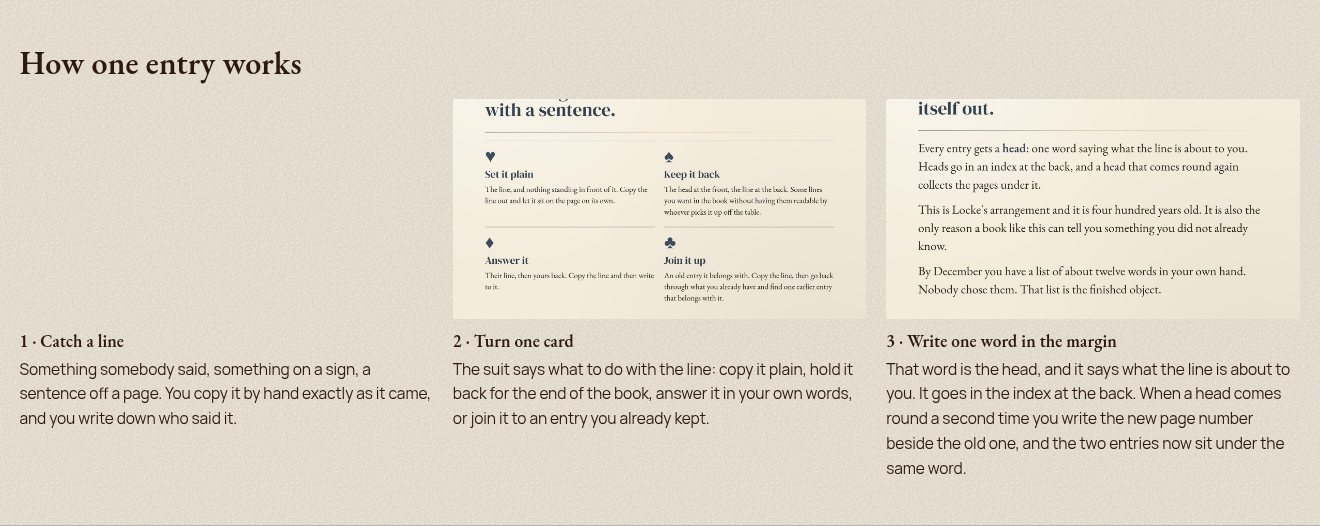
You catch a line somebody said and turn one card. The suit decides how the line goes on the page: copy it plain, hold it back for the end of the book, answer it, or join it to an entry you already kept. The rank sends you somewhere to find the next line.
Then you write one word in the margin and add it to the index at the back, just as above.
Every seventh entry is an “Hour”, which sends you back through the lines you already kept instead of asking for a new one. There are eleven of them. Nothing is due on a date, so there’s no streak to break.
The download is four print-ready PDFs: the 20-page illustrated book, three printable sheets (the reference card, the index and the Hours record) and printer-friendly copies of both. It has a dark academia look, with night skies, moths and a moon. If you want to decorate your pages to match, here are five ways to make dark academia scrapbook pages.
The Commonplace Hours is also one of the four games in The Game Bundle, and one of the seven in The Seven Game Bundle, if you’d like more than one kind of notebook to come back to.
FAQ
What should I put in a commonplace book? Lines somebody really said or wrote: from books, conversations, signs, letters. Add who said it and a one-word heading for what it means to you.
Can a commonplace book be digital? Yes. A notes app or document works if you keep the same habits: copy the line exactly, note the source, and tag it with a head word. Copying by hand does make you slow down and choose.
Is a commonplace book the same as a journal? Not quite. A journal is mostly your own thoughts and days. A commonplace book is mostly other people’s words, filed by subject.
Do I need a special notebook? No. Any notebook you can number works. Leave a few pages free for the index.
Start your commonplace book today
Find a notebook, number the first ten pages, and leave two blank for the index. Then copy down the next good line you hear today, with who said it and one word in the margin. If you’d like the cards to keep you going after that, have a look at The Commonplace Hours.
Leave a Reply