
The Ironsworn solo RPG is a free dark fantasy tabletop game by Shawn Tomkin, played alone with three dice and a journal. You swear an Iron Vow, make moves to pursue it, roll a six-sided action die against two ten-sided challenge dice, and write down in the journal what happened after each roll.
Most people download it, read the moves twice, then sit looking at a blank notebook wondering what goes on the first page. That gap between owning the game and starting it is where the stalling happens.
What follows is a setup order for keeping the game as a physical book you make by hand, rather than a document on a laptop. Six steps, from the free download to a finished vow marked on the page.
The rules cost nothing. The book is yours, and that is the half nobody writes instructions for.
Table of Contents
What an Ironsworn solo RPG session actually looks like on paper
Ironsworn is a dark fantasy game set in the Ironlands, a cold frontier where people scrape a living at the edge of somewhere worse. Shawn Tomkin released it in 2018. It was built to be played alone as readily as with a group, and the digital edition has been free the whole time.
A session of the Ironsworn solo RPG runs as a loop. You say what your character is doing, you find the move that covers it, you roll, and the result tells you whether it went well, went well at a price, or went wrong.
Then you write. The writing is not an extra bolted onto the rules, it is the thing the whole system exists to produce. A made book holds it better than a notes app.
Step 1. Download the Ironsworn solo RPG rules, then pick the book
The free digital edition lives on Tomkin Press, the author’s own publishing site, and the same download sits on Shawn Tomkin’s itch.io page. It runs to 270 pages and arrives with a playkit and printable asset cards.
Print the moves reference and the asset cards. Leave the rest open on a screen beside you, the way you would leave a recipe book open on the bench.
For the journal, an A5 hardback with thick pages will take ink and glue without buckling. If you already make junk journals, use one you have made. Coming the other way, from the gaming side, our guide to what a junk journal is covers the materials.

Step 2. Build the front matter your Ironsworn solo RPG needs
An Ironsworn solo RPG character comes with a handful of numbers to keep, and the book works far better when they live in one fixed place instead of migrating through the pages. Give the first opening of the journal to them and never write a scene there.
On the left page go your character’s name, their five stats, and their assets. The stats are edge, heart, iron, shadow and wits, and they are the small numbers you add to a roll. Assets are the cards that say what your character is good at, anything from an animal companion to a combat talent or a ritual.
On the right page go the four tracks. Health, spirit and supply each run from nothing up to five. Momentum runs from minus six to plus ten and tells you how the quest is faring overall.
Draw those tracks as boxes you tick and cross, not as numbers you rub out. A crossed-out row of health still reads three months later. A smudged pencil 3 does not.
Step 3. Swear your first Iron Vow, and give it a spread

The Iron Vow is the spine of the game. When you commit to a quest you write the vow down, give it a rank, and roll +heart, which means rolling the six-sided action die and adding your heart score.
A strong hit gives you two momentum and a clear next step. A weak hit gives you one momentum and more questions than answers. A miss drops something in your way before you can begin, and you either press on at a cost or forsake the vow.
Ranks run troublesome, dangerous, formidable, extreme and epic, and the rank sets how fast the track fills. A troublesome vow marks three boxes each time. Dangerous marks two, formidable marks one, extreme marks two ticks and epic marks a single tick.
Each box holds four ticks and every track is ten boxes long. That is the number to design the page around.
Here is the part the rulebook leaves to you. Rule the ten-box track by hand across the top of a fresh opening, wide and in ink, then write the vow underneath it in the words your character used.
Rule the track in ink, wide, before there is anything to record on it. A page that already has room for the story tends to get one.
The rest of that opening stays empty and fills as the quest does. Reading back through an Ironsworn solo RPG journal a year later, those half-filled tracks are the thing that brings the night back.
Step 4. Make one move and write down what the dice said
Every uncertain action in the Ironsworn solo RPG goes through a move. Face Danger, Secure an Advantage, Gather Information, Make Camp, Undertake a Journey and the rest each tell you what to roll and what each outcome means.
An action roll is three dice thrown at once. One six-sided die is your action die, you add a stat to it, and that total goes up against two ten-sided challenge dice.
Beat both and it is a strong hit. Beat one and it is a weak hit, which is success with a price attached. Beat neither and it is a miss.
When the two challenge dice land on the same number, something larger is going on than the move by itself. Take a match as the game handing you a twist.
Write the entry straight away, while the roll still stings. Two or three lines in your character’s voice, not a report on what the dice did.
What to record after each move in an Ironsworn solo RPG
A page that holds only prose loses the game underneath it. A page that holds only numbers is a spreadsheet. Five things, every time, keeps it readable for years.
- The move you made, abbreviated in the margin. Something like Face Danger, +iron.
- The outcome, as one mark beside it. A tick for a strong hit, a half tick for a weak one, a cross for a miss.
- What happened, in your character’s voice, at whatever length the moment earns.
- Any track that moved, marked on the front opening rather than buried mid-page where you will never find it again.
- One thing for your hands. A scrap of map, or a torn edge of paper in the colour of that night’s weather.
That last line is what separates an RPJ from a pile of notes. RPJ is short for role playing journal, the community’s own name for this, and most of the people using it came to Ironsworn from junk journalling rather than from tabletop gaming. The making is why they stay.
Step 5. Ask the oracle, then glue something in
Solo play removes the person who would normally answer your questions, so the Ironsworn solo RPG hands you the Ask the Oracle move and a long run of random tables. You can ask a yes-or-no question with odds attached, or roll on a table for a name, a place, an action or a theme.
An oracle table is a numbered list you roll against, and the number is never the answer. The answer is what you decide the result meant. That decision is where a solo game stops being arithmetic.
Keep a glued-in pocket near the back for results you have rolled but not used yet. Write them on small cards, pull one when a scene needs a shove, and glue the spent card onto the page it caused.
Step 6. Mark a fulfilled vow so the page shows it
Progress in an Ironsworn solo RPG does not come from ticking a box whenever you feel like it. You mark progress when you Reach a Milestone, which the rules define as overcoming a real obstacle, finishing a hard journey, solving a mystery, or winning support you needed.
Once the track holds enough filled boxes, you make the Fulfill Your Vow move. This one is a progress roll and it works differently: you do not roll the action die at all. You count your filled boxes and compare that number against the two challenge dice.
Bonds run on a track of their own. Each time you Forge a Bond with a person or a community you mark one tick, and when a character’s story ends, Write Your Epilogue tallies those bonds the way a vow is tallied.
On paper, a fulfilled vow is worth more than a tick. Ink the ten boxes solid, date it, and hand the facing page to one image of the thing you swore to do, finished.
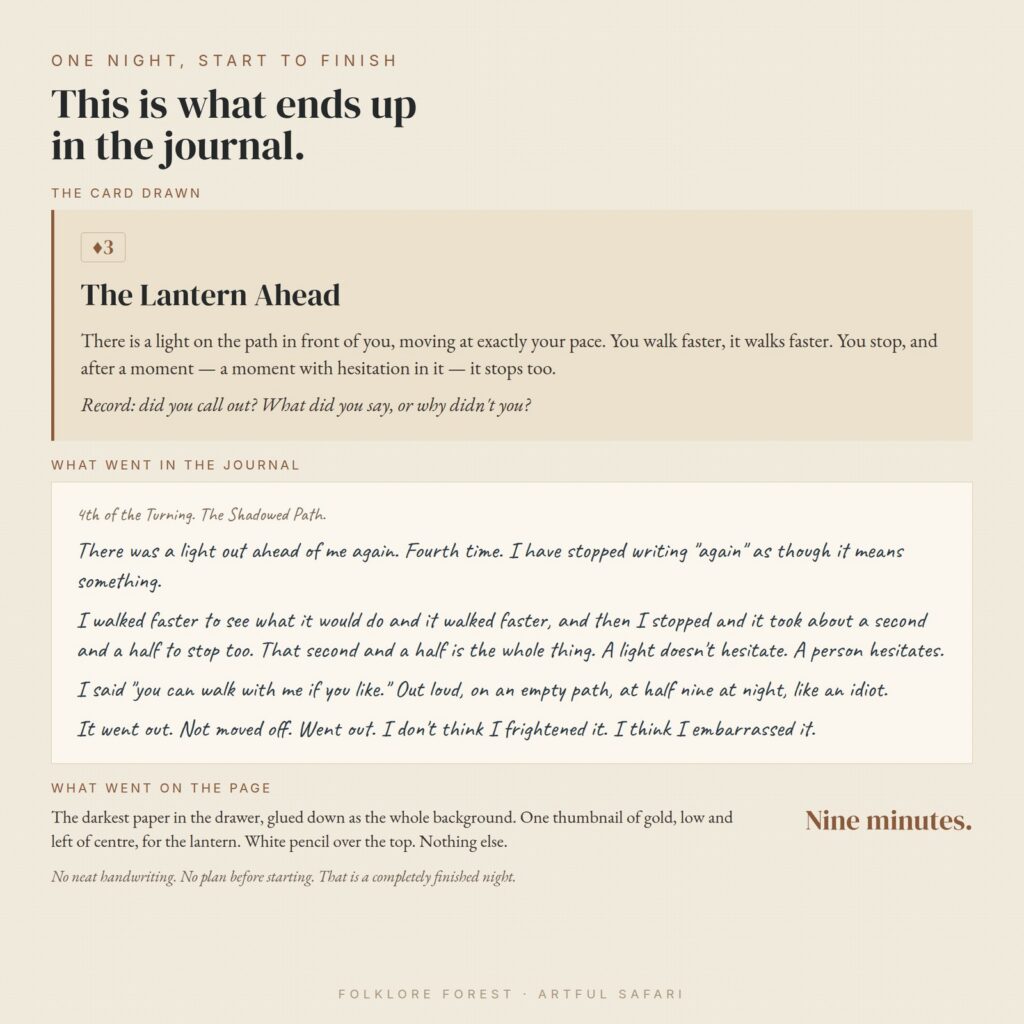
That opening is what you turn to when somebody asks what an Ironsworn solo RPG actually is. It gets there faster than the rulebook.
What goes wrong in a first Ironsworn solo RPG journal
Swearing an epic vow first is the common one. An epic vow marks a single tick at a time and a full track is forty ticks, so the book stalls long before the story does. Swear something troublesome and finish it.
Writing on loose sheets with the intention of binding them later almost never ends in a bound book. Start in the hardback even if the first page comes out scruffy.
Decorating the whole journal before you play tends to make it too precious to write in. Build two or three openings ahead of the story and stop there.
Recording the dice instead of the character is the one people regret. Six months on, “8 against 4 and 9, weak hit” tells you nothing. What your character did about it tells you the lot.
Thin paper is the last one. Fountain pen ink and wet glue will find it, so test a sheet before you commit forty nights to a book.
Common questions about the Ironsworn solo RPG
How do I actually start once I have downloaded the game?
Make a character and swear one troublesome vow tonight, before you decorate anything. The usual stall is treating setup as a project, printing the whole rulebook and buying a journal and never rolling. Do the front opening from step two in half an hour, swear a small vow, make one move, write four lines.
Do I need dice to play Ironsworn?
Yes, one six-sided die and two ten-sided dice. That is the whole set. If you do not own ten-sided dice, a dice-rolling app does the same job, and plenty of people roll on a phone with the paper journal open on their knee.
Do I have to be good at writing?
No. Nobody reads an Ironsworn solo RPG journal except the person writing it, so there is no one to find a plot hole or mark a sentence. Four lines in your character’s voice does the job. The people who stay with this longest tend to write short and glue in more.
How long does one session take?
Ten minutes to a couple of hours, and the short ones are normal. One move, one entry and one thing stuck to the page is a complete evening. It suits interrupted schedules, because you can put it down mid-quest and pick it up three weeks later without rereading anything.
Is the Ironsworn solo RPG really free?
Yes. The digital edition, the playkit and the printable asset cards are free from Tomkin Press and from itch.io, and what you get is the complete 270-page rulebook rather than a sample. Shawn Tomkin also sells printed editions and a science fiction follow-up called Starforged.
Can I use a junk journal I have already made?
That is the best book for it. A junk journal already has pockets and mixed papers, which is what an Ironsworn solo RPG needs for oracle cards and vow tracks. Leave the first opening blank for your character and tracks, then work forward. Pages you decorated months ago will steer scenes, which is worth having.
Where an Ironsworn solo RPG goes next
Watching somebody play clears up the loop faster than reading about it does. Dave Thaumavore’s walkthrough of Ironsworn and how its mechanics work takes the dice, the vow ranks and the oracle in order, with examples on screen.
Plenty of people keep a second, shorter game running alongside a long campaign, for nights when forty ticks feels like a distance. Our guide to how a solo journalling RPG is built pulls the format apart, and the first seven nights guide is a slower way in.
Either way, the book is the part you keep. An RPJ made from papers you actually like is a better home for a long Ironsworn solo RPG than a stack of printouts, and printing your own is covered in our home printing settings guide.
If you want the paper side sorted before you swear your first vow, our Folklore Forest kit pairs woodland papers and ephemera with a 52-night game of its own.