
Apothecaria is a solo journaling game by Anna Blackwell in which you play a village witch, treating patients who arrive with ailments like Fairy Fever using potions you brew from foraged reagents. It runs on a deck of playing cards across four seasons of thirteen weeks each, and everything that happens gets written into a journal you keep.
What nobody explains is what that book should look like after thirteen weeks.
One player said it under Shannon Green’s flip through: “I bought the game a while back and have been trying to figure out the journal setup.” That is the common stall, and it has nothing to do with the rules.
So this is a guide to the book. Seven ways to set an Apothecaria journal up so the thing on your shelf at the end of Spring is worth opening again.
Table of Contents
What Apothecaria asks you to write down
Anna Blackwell’s game runs on a standard deck of playing cards and a calendar of four seasons, thirteen weeks apiece, opening on the first day of the first week of Spring. A round moves through diagnosis, foraging and potion preparation. Each of those wants a different kind of page, which is why one repeating notebook layout never quite holds it.
Diagnosis hands you a patient and an ailment carrying reagent tags, so Yeti Chest wants two reagents that answer hair and lungs. Foraging sends you to Glimmerwood Grove, Meltwater Loch, Moonbreaker Mountain or Hero’s Hollow, and the card you pull out there brings an event along with the ingredient. Potion preparation is where the recipe gets written out and where you learn what the work was worth.
The publisher’s page for Apothecaria carries the digital version and the hardback both. To watch a round go by before you commit, this review plays one out from patient to finished potion.

The people doing this call the result an RPJ, short for role playing journal. Journals4breakfast coined it on camera in July because the long version is too many words to say twice. Five weeks later it was in video titles on three channels and in the name of the community’s Discord.
1. Choose the book before you print a page
The decision that shapes an Apothecaria journal most is the book you play inside, and it is the one people leave until last. Shannon Green went with an altered book, gluing her printed pages into an old Russian-English chemical dictionary. It reads like something pulled off a shelf in a back room rather than bought this morning.
A hardback with foxed paper and a cracked spine has done most of the atmosphere before you write a word. It also lowers the stakes on neatness, which matters more than it sounds when week three arrives and you have glued something in crooked.
Shannon Green is playing Apothecaria as an altered book right now, and this is where her series starts. Watch it first if you are looking at a stack of printed pages and an empty desk.
2. Dye the paper before you glue anything down
Coffee turns fresh printed pages the colour of paper kept in a still room for forty years, and it costs an afternoon. Shannon dyed her journal pages and her playing cards in the same session, which is the part worth copying. A bright white deck on aged paper looks wrong the moment you deal the first card.
Do it while the sheets are loose. Wet paper cockles as it dries and that texture is half of what you are after, but it has to happen before anything gets bound or glued in.
Her coffee session covers the cards as well as the pages, and the tabbing at the end of it feeds straight into the next step.
3. Tab the seasons so you can find week six
Fifty-two weeks of Apothecaria in one book means you will be hunting for things by October. Tabs down the fore edge, one per season, take ten minutes and save the rest of the year.
Run a second set of tabs on the reference sections, because those are the pages you open every single round. The herbal and the patient ledger want to be findable with a thumb.
4. Give the herbal a spread it repeats
The herbal is the part of an Apothecaria journal you return to most, since every potion sends you leafing back through it. Build one slot per reagent and keep that slot identical the whole way down the page.
Four things belong in a slot: the name, where it was found, the symptoms it answers, and how it has to be prepared before it goes near a pot. Rule them the same way every time and the page still reads in week eleven, when you have thirty reagents and no memory of the first ten.
Keep the four foraging areas apart rather than running one alphabetical list. Glimmerwood Grove filling up while Hero’s Hollow stays nearly empty tells you something true about how you have been playing.
Shannon’s first pass at her own journal shows how much structure to build before you start, which is less than most people expect.
5. Write the brew up like a working recipe
A finished potion is worth money in Apothecaria, and the ingredients you picked move that number. Sweet reagents lift the value and poisonous ones pull it down, so the recipe page records a decision as much as a result.
Write it as numbered steps, the way a recipe card reads. One reviewer’s sample brew ran to eight steps, from preparation through to how the finished bottle was stored, and that length is about right if you want a working book instead of a summary.

Leave a line at the bottom for what it sold for and whether the patient came back. Reputation is a real quantity in this game and a missed deadline costs you some of it.
6. Press and mount what you gathered
This is where a junk journal earns its place over a notebook. Gas Weed and Wigfish do not grow anywhere, but a pressed fern and a torn strip of old map stand in for them well enough on the page.

Mount one specimen per reagent on the herbal spread with the name written underneath. If you already keep a junk journal you own every tool this needs, which is why so many players arrived here from craft rather than from gaming.
Journals4breakfast calls it shopping her own stash. Her line about it, repeated back at her in the comments ever since, is “It was like shopping but free!”
7. Keep the villagers on one page
Patients recur in Apothecaria, so they deserve a ledger instead of being scattered through fifty-two weeks of entries. One line each: name, what they walked in with, what you gave them, whether it held.
Leave space to the right of every line. Somebody who turned up with Toad Nose in week two will be back, and the second visit plays far better if you can see the first one without hunting.
What a finished Apothecaria spread looks like
Watching one beats reading about one. Shannon’s flip through of weeks four to seven is the clearest look at what an Apothecaria book turns into once the seasons get going.
The Spring week three playthrough is the other one to watch, because it catches the writing as it happens rather than the finished page.
A viewer under that playthrough wrote that Shannon’s offhand answers “took off any pressure I had felt about having to come up with an elaborate story to start with.” Watching somebody shrug at a card and move on does more for a stalled book than reading the rules twice.
Apothecaria questions people actually ask
Do I need dice to play Apothecaria?
No. Apothecaria runs on a standard deck of playing cards, jokers included, and that deck decides who walks in and what you find when you go out looking for ingredients. Plenty of players swap in a tarot or oracle deck instead and read the cards their own way, which changes the flavour and nothing else.
Do I have to be good at writing?
No, and the people already playing say so constantly. Journals4breakfast puts it this way: nobody is ever going to critique your character development, because the book is yours and nobody else reads it. Shannon Green’s playthroughs are full of moments where she shrugs at a card, writes one line and moves on.
How long does a week of Apothecaria take?
As long as you let it. A round is diagnosis, then foraging, then writing up the potion, and the writing itself is short. The time goes into whatever crafting you attach to it, which is why The HalFass Crafter describes the hobby as something you can pick up and put down instead of getting mired in an hours long session.
I have the game and a journal. How do I actually start?
Play Spring week one and write down only what that round produced. The stall almost always comes from trying to build a finished herbal and a decorated cover before a single card has been turned over. Set up two pages, play one round, and let the rest of the book grow out of the play.
Do I have to print Apothecaria myself?
No. The publisher sells a physical copy of the book as well as the digital version, and buying the physical one includes the digital. If you do print it, keep the pages loose so you can dye and age them before they go into whatever book you have chosen to play inside.
Starting your own Apothecaria journal this week
Print the pages, dye them, glue or bind them into the book you picked, and give yourself Spring week one and nothing past it. The people who stall are usually the ones who tried to build the whole herbal before playing a round. If printing is the part holding you up, the home settings that actually work are here.
If you have never played anything like this, our guide to solo journaling RPGs covers what the category is and how one evening of it really goes.
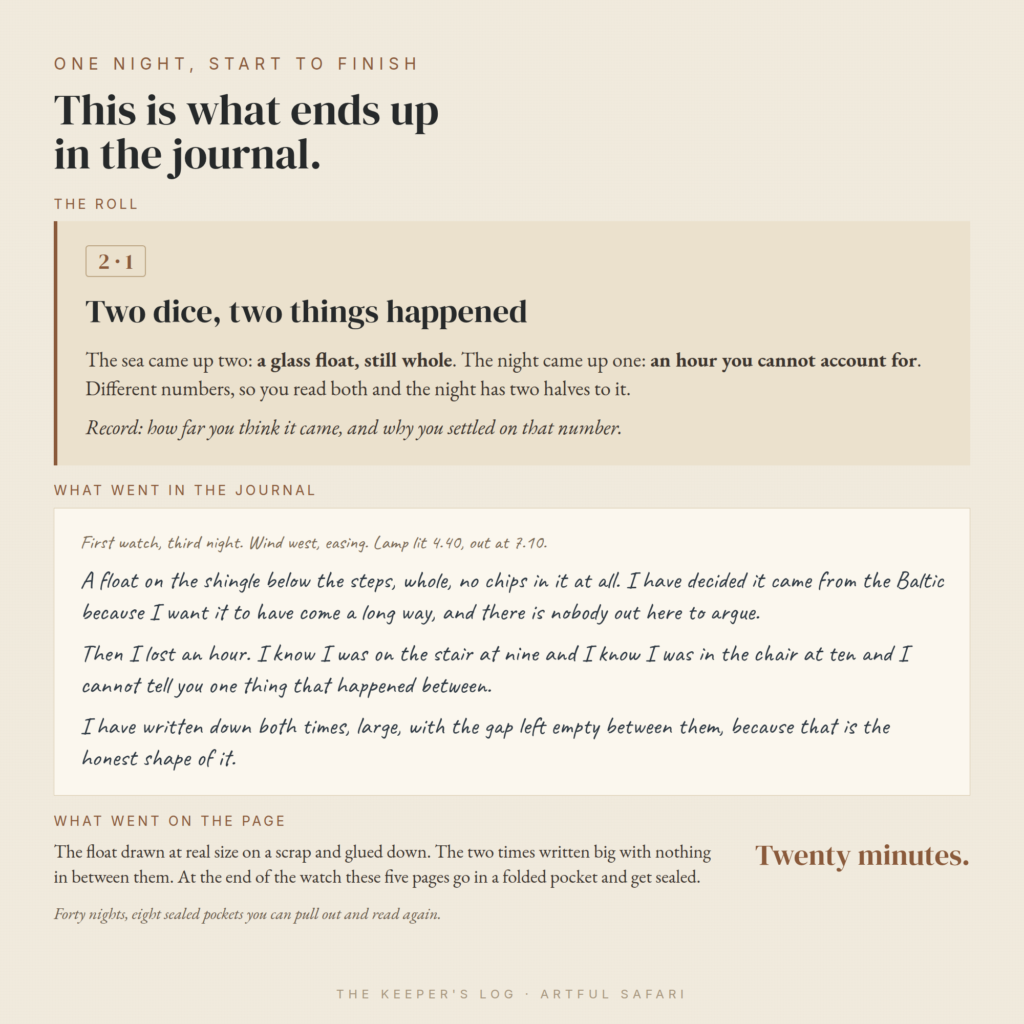
And if you want a shorter RPJ to run alongside Apothecaria while the seasons turn, The Keeper’s Log is forty nights in a lighthouse, played with two dice.