
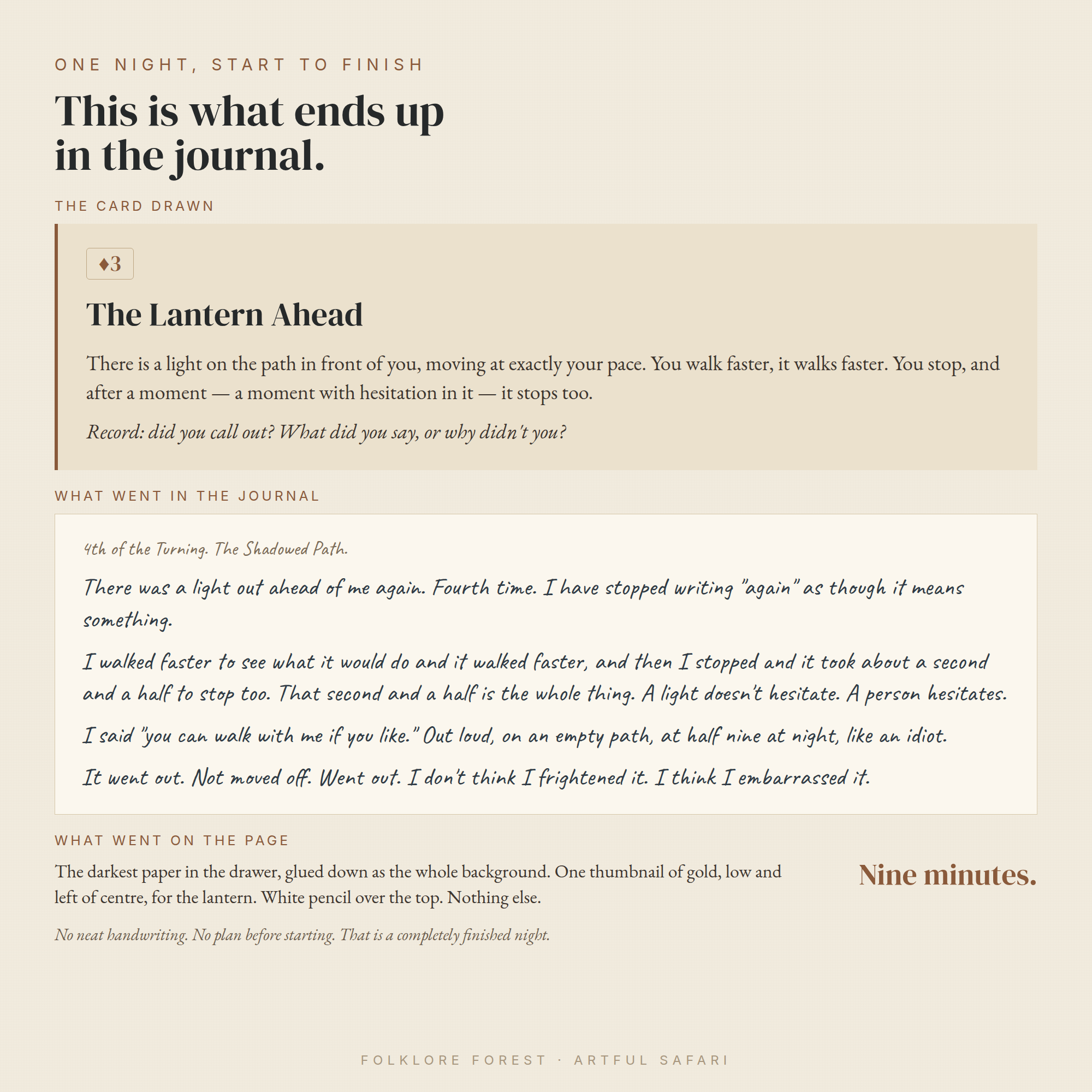
A solo RPG is a story you play by yourself and write down, one prompt at a time, in a book you keep. Nobody else is involved and there is nothing to memorise. A lot of people now play in a decorated journal rather than a notes app, and you can start tonight with a notebook you already own.
If the letters RPG make you want to run for the hills, you are in the majority here. The women arriving at this hobby this year mostly came from junk journalling and scrapbooking rather than tabletop gaming, and they say the same thing on the way in: they had no idea what an RPG was and assumed it was for somebody else.
The craft side of it has its own word now. The YouTuber Journals4breakfast started calling these books RPJs, short for role playing journals, because “solo journaling roleplaying game” is too many words to say out loud.
RPJ is what you will see in the comments. Solo RPG is what you type into a search box.
Her video is the one that pulled thousands of journallers into this, and it is the fastest way to see why the reframe works:
Table of Contents
What a solo RPG actually asks you to do
You read a prompt. You answer it in your journal, in whatever mix of writing, pictures, stickers and glued-down scraps suits you. Then something random decides what happens next, usually two dice or a card off the top of a deck.
That is the whole loop. Nobody marks it and nobody reads it, so there is no wrong answer, and that is the part most people take longest to believe.
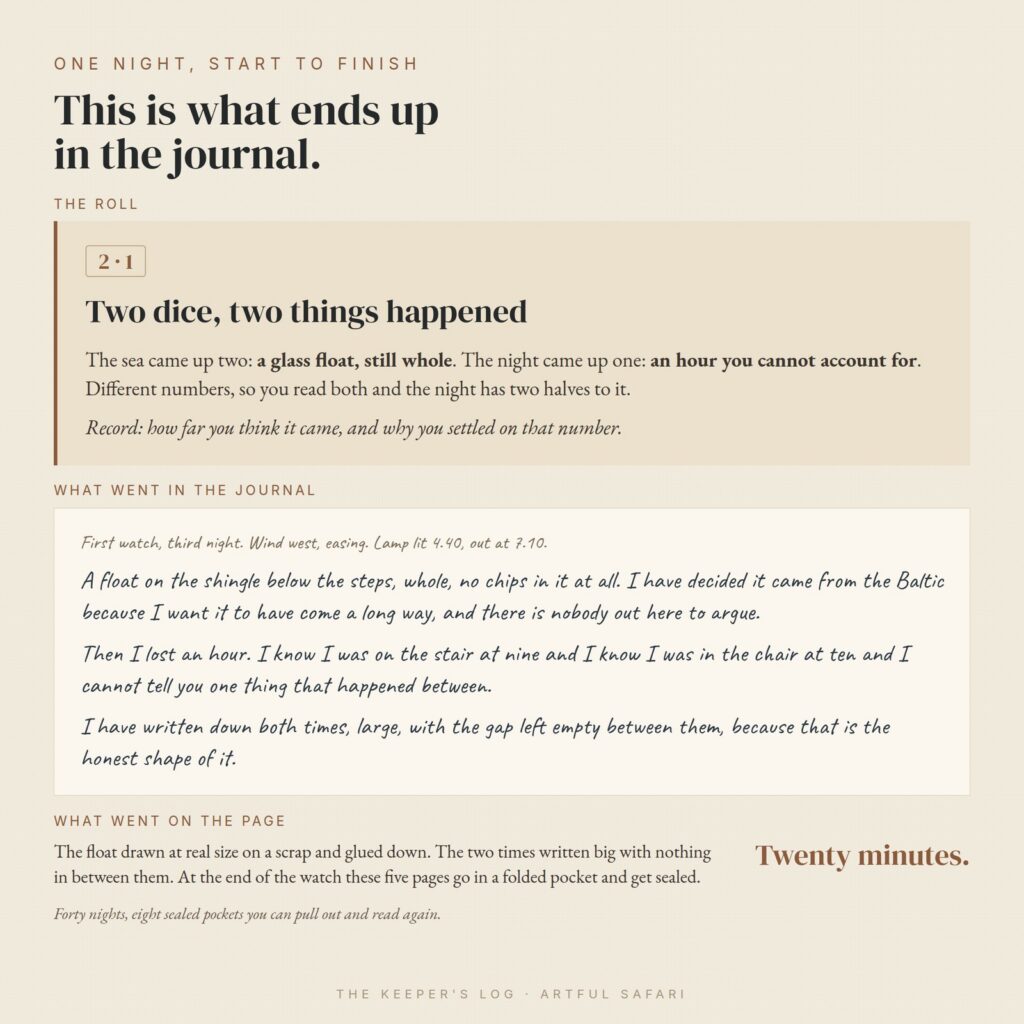
If you want the long version before you start, we walk through an evening of it in the complete guide to a quiet night of solo journaling.
Eight different doors into a solo RPG, then. Some cost nothing, one costs about the price of a coffee, and several use only what is already in the house.
1. Print a free solo RPG tonight
Itch.io is where most of the small independent games live, and a large share of them are free or name-your-own-price. Browse the solo journaling tag on itch.io and pick one on the strength of its cover, because at zero cost the wrong pick costs you nothing.
Most of these books run to twenty pages or fewer and print on plain paper. If your printer fights you, our notes on printing journal papers at home cover the settings that usually sort it out.
2. Buy a small one for about five dollars
Five dollars is the going rate for a starter game and it is the number people in this community quote at each other constantly. What you get is a slim book of prompts and random tables somebody else has already thought hard about, which is the part that is genuinely difficult to write yourself.
When newcomers ask which one to begin with, the titles that come back most often are Apothecaria, Colostle and Thousand Year Old Vampire. Any of them will teach you the shape of a solo RPG.
3. Use the notebook that has been sitting there
Almost everyone in this hobby owns a beautiful blank book they have never been able to spoil. This is the thing it was waiting for.
“I’ve got a journal just like your one that I never knew what to do with, now I do.”
That comment, or a version of it, sits under every video that started this wave. Your stash gets used the same way. Stamps, washi, offcuts and that pack of stickers bought in 2019 all have somewhere to go once a prompt tells you what the page is about.
4. Let a standard deck of playing cards decide
Games ask you to pick a number at random so the story can surprise you. Two ordinary dice do it, and so does taking the ace through six out of a deck, shuffling those and turning one over.
A card also suits anyone who freezes at a blank page, because it gives you something to answer. Some games hand you a deck of character cards instead, so the person who turns up in tonight’s entry is whoever you draw.
Artful Safari’s own games are designed for a standard 52-card deck of playing cards, not tarot.
Nobody checks any of this. If a game asks for a ten-sided die and you do not own one, two cards or the number generator on your phone will carry you through the first few nights.
5. Turn a junk journal you already made into the solo RPG book
Junk journallers keep hitting the same wall. They love making the books and then have nothing to put in them, and a solo RPG turns out to be the answer to “now what”. That collision is most of why the two hobbies met this year.
Pick a finished book, decide it belongs to your character, and write entries into the pockets and tucked-in tags you already built. If you have not made one yet, start with what a junk journal is and build it around the game instead.
6. Glue the pages into an old hardback
An altered book gives you a solid spine and a bit of history for free. One creator printed her game and glued the pages into an old Russian-English chemical dictionary, which sounds mad and looks wonderful.
Charity shops are full of candidates. A fat hardback nobody wants takes glue and paint better than a new notebook does.
7. Watch a solo RPG being played before you set anything up
The quickest way past “I do not understand what I am looking at” is watching somebody do it imperfectly on camera. Shannon Green works through free games and shows the printing in this one, and that is where a lot of people get stuck:
The comment left under videos like that one, over and over: “Thank you for legit playing the game. It makes sense to me now.”
8. Answer one prompt on one page and stop
The smallest possible start is one solo RPG prompt, one page, book closed. You do not need a character sheet or a plan for the rest of it.
This is the door for anyone who has bought a game and then stalled, which is a large group. One page done badly beats a beautiful book you never open. Our first seven nights walkthrough takes it from there.
Setting up a solo RPG is part of the game, not the wait before it
Plenty of people spend a long time building the book before they read the first prompt, and they are not doing it wrong. Tabbing, colouring, coffee-dyeing, hunting the stash for the right scrap: that is the hobby, and for a lot of this crowd it is the best bit.
So “start tonight” means you can open the box tonight. It does not mean you should be finished by Sunday.
Where the solo RPG community is, if you want company
The tabletop side lives on Reddit at r/Solo_Roleplaying, which is worth reading even if you never post. Search it for “journaling game” and you will find hundreds of threads of people recommending titles to each other.
The craft side is on YouTube and in a small Discord, and it is friendlier to an absolute beginner. Both are free.
Solo RPG questions people actually ask
I bought one and I still have not started. What do I do?
Open the journal and answer the first prompt in three sentences tonight, with a biro. The stall nearly always comes from waiting until the book is ready, and the book is never ready. Once there is one imperfect page in it the pressure drops and the decorating gets easier, because now you are decorating something that exists.
Do I need dice to play a solo RPG?
No. Most of our games use a standard 52-card deck of playing cards; only The Keeper’s Log uses two ordinary dice. People do buy dice as a small entry ritual and there is nothing wrong with that, though waiting for a set to arrive is one more reason not to start, so use the cards in the kitchen drawer.
Do I have to be good at writing?
No, and nobody will ever read it. Most players write a few lines and put the rest on the page in stickers, stamps, washi and glued-down scraps. One of the creators who started this wave says she has barely written a word and works mostly in watercolour, and a shopping list in your character’s handwriting counts as an entry.
Which solo RPG should I start with?
Start with a free one so the choice costs nothing, then buy a paid game once you know what you like. If you want a paid recommendation, Apothecaria, Colostle and Thousand Year Old Vampire are the ones this community hands to newcomers most often. Picking a theme you already love matters more than picking the “right” title.
Is a solo RPG the same thing as an RPJ?
Yes, near enough. RPJ stands for role playing journal, a word coined by Journals4breakfast in July 2026 for the craft version of this hobby, where the book itself is half the point. Solo RPG is the older and broader term, and it covers people playing in a plain notebook or a text file too.
How long does one night take?
That is up to you. A sitting is usually one prompt and one page. Some people write a few lines and stop, and some get lost in the collage. You can put it down mid-entry and pick it up again whenever you like without losing your place, which is why it fits around interrupted schedules.
Pick a door and open it
Any of the eight gets you a first page tonight. The free ones are the sensible place to test whether a solo RPG is your kind of thing at all, and you will know within one entry.
When you want the papers and cut-outs to build the book around, our Folklore Forest kit pairs a solo RPG, played with a standard 52-card deck, with the journal papers and ephemera to keep it in.