
Artefact is a solo journaling RPG by Jack Harrison, published by Mousehole Press. You play the magical item rather than a person: a sword, a pair of boots, passing through the hands of one Keeper after another across centuries, while the journal you write becomes the object’s own memory.
That is the game, not the ordinary English word that happens to share its spelling. The swap is why Artefact suits a made book better than almost anything else in the hobby, since the object outlives everyone who ever holds it.
Five ways below to make the book carry that instead of just describing it.
Table of Contents
What Artefact actually asks you to do
You begin by choosing what kind of Artefact you are. The list runs to nine: The Weapon, The Shield, The Instrument, The Ornament, The Deck, The Footwear, The Staff, The Tome and The Automaton.
Each type opens with a question written for it alone. The Weapon starts at the forge that made it, and the smith who swung the hammer. You answer it, sketch yourself, and take your starting traits from a list or write your own.
Then the Keepers arrive. A Keeper gets a name and a few details, two prompts about how they used you, and one memorable event with an outcome.
Good outcome or bad, you take a Change from the matching list, so the object comes out of it altered either way. Then you work out the circumstances that lost you.
The Keepers arrive in three eras. The object is newly forged in the first, passes through a time of glory in the second, and reaches ruin in the third.
Between Keepers the game makes you sit with the passing of time. You pick how long the gap is, and the longer the gap the longer you stay in silence before writing again.
A month is twenty seconds. A century is two minutes. A millennium is four.
A long stretch of neglect also pulls a prompt for what the years did, so the world around the object either holds steady or decays.
The publisher’s own page calls it “a story game for one player, designed for contemplative solo play” and puts about an hour on a sitting.
If you would rather see the book before you buy it, Dave Thaumavore turns the pages on camera and shows how one Keeper section is laid out:
The craft side of this hobby has started calling these games RPJs, short for role playing journals. Of all the RPJs going around at the moment, Artefact is the one that pays back the most for treating the journal as the real object.
1. Build the book as the Artefact’s own record
Most journaling games leave you writing as a person, so a diary layout fits them. This one does not, because the book is the object.
The first spread is the making, not a title page about you. Whatever you answered to that opening question goes down in full, with your sketch of yourself beside it and the whole opening given over to the forge or the workshop.
One small decision changes how the entire book reads: date the spreads by the object’s reckoning rather than ours. “Third winter after the forge” carries more than “1482” when nobody has told the object what year it is.
Hold the voice to that as well. An object cannot know what happened in the next room, and a book that never breaks the rule is much stranger to read back.
2. Give every Keeper their own spread
One Keeper, one opening, and the layout identical across all of them so the differences do the talking. Same panel for the Keeper’s name, same corner for the memorable event, every time.
Let the papers follow the three eras Artefact already set up. The first Keeper’s spread can run light and clean, the second heavy with pattern and gilt, the last torn back to something plainer and darker.

Someone flipping the book should feel the centuries turn before they read a word. A screen cannot do that.
3. Age the paper between the eras
The silence between Keepers is the best thing in the game and the easiest to lose in a journal, because nothing happens on the page. Give it a spread anyway.
Leave it empty apart from one line saying how long passed, then treat the spread physically. Tea-stain it, or glue in something that has visibly survived a long time.
Let the prompt decide how far you go. A decay prompt should show the damage on the paper itself, while a prompt about the changing world outside stays intact and puts the shift beyond the object.
This is where a scrap box earns its keep. Anything already stained, torn or foxed belongs in the rest spreads, because that is the only part of the book where wear counts as content rather than as a mistake.
4. Keep the Changes where you can flip back to them
The Changes are the object’s whole arc, and they disappear if they only exist inside the paragraph where they happened. Build a running record for them near the front of the book.
A tabbed page does it. Write the starting traits with room underneath each one, then strike a trait out rather than rubbing it away when it is replaced, so the object’s history stays readable on a single page.
Put the sketches there too. Redraw the Artefact after each Keeper, smaller, in a row across the bottom, and by the end the whole life of the thing sits in one line of drawings.
What a finished Artefact spread looks like
Left page is the Keeper. Name at the top, a portrait or something standing in for one, and the two prompt answers written as the object watching them rather than as a biography.
Right page is what they did with you. The memorable event takes the largest block of writing on the spread, the Change sits underneath it in a different colour, and the loss is one line at the foot of the page.
Everything else is texture. Ledger paper behind the writing, a strip of something ruined down the gutter where two eras meet.
A finished Artefact book should read like an archive somebody else kept and you found. The game says that is what the book is.
5. End the book the way the Artefact ends
Every Keeper loses you, and the last loss ends the Artefact’s story. It deserves better than a paragraph tucked into the bottom of a spread.
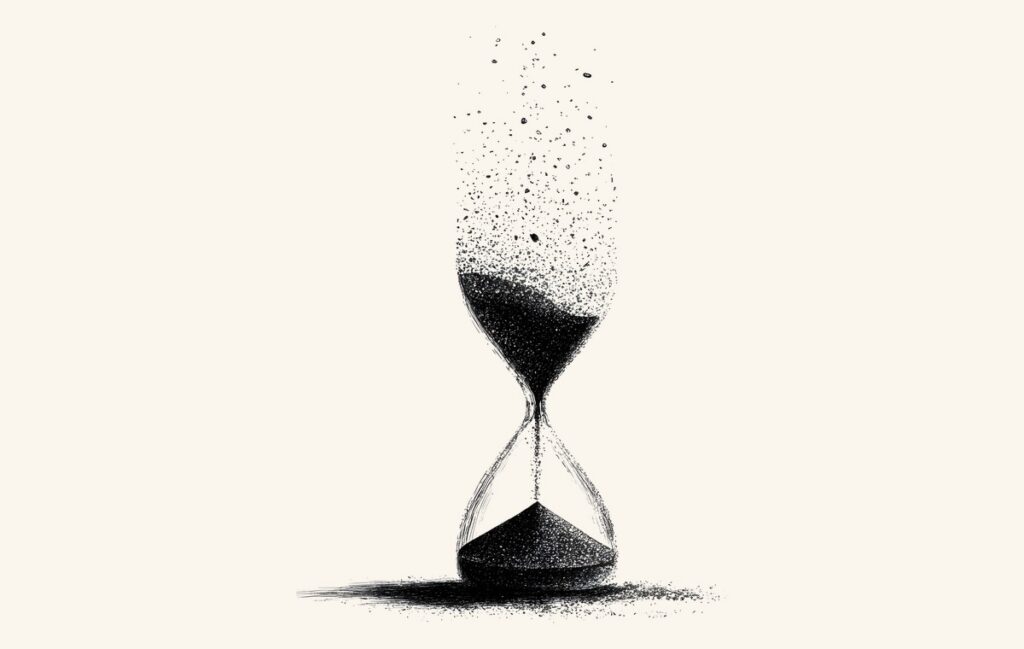
Close with a final page holding nothing but the object. Buried, sunk, melted down, or shelved in a collection where nobody left alive knows what it is.
One image and one line will do it. Some players seal that last page shut along the edge; others glue an envelope inside the back cover, put the object’s final trait in it, and leave whoever reads the book to decide whether to open it.
Papers that can carry several centuries
The supply problem this game creates is an odd one. A single Artefact book has to cover several eras and still look like the life of one object, and buying a separate kit per era is exactly how a book stops holding together.
One set with range inside it works better. A lighter stock for the first Keeper, the same palette pushed darker and heavier by the last, so the book ages instead of changing character halfway through.
Helene designs the Artful Safari sets to stay inside one palette family for that reason. If you are printing at home, our guide to printing junk journal papers at home covers the settings that stop a dark era page going muddy, and if the made-book side of this is new, read what a junk journal actually is before you cut anything.
Artefact questions people actually ask
Do I need dice to play Artefact?
No dice are needed to work through the book. The publisher describes the game as drawing and some writing, and play runs on questions you answer and lists you pick a Change from rather than on rolls. If you would rather have the choice taken out of your hands, the download includes a Keeper generator that throws up random Keepers for you.
Do I have to be good at writing?
No. The prompts do the heavy lifting, and plenty of people in this hobby answer them in a line or two and spend the rest of the evening on the page itself with stamps, tape and paper. Nobody reads the book but you, so nobody is going to find a plot hole in it or ask you to defend a draft.
How long does a game of Artefact take?
The publisher puts about an hour on a sitting. A book runs through a run of Keepers rather than one, so most people spread it over a few evenings, and the game carries on until the object has had its last Keeper.
I bought it and I still have not started. Where do I actually begin?
Start with the opening question for your item type and nothing else. That single answer, written out in full on the first spread with a sketch beside it, is a whole session’s work and it puts the object on the page. The stall almost always comes from trying to set up the entire journal before the first word goes down.
What is an RPJ?
RPJ is short for role playing journal, the name this crafting community gave to solo journaling games played inside a handmade book. It was coined on camera in July 2026 by the YouTuber Journals4breakfast and picked up within weeks by other makers. Artefact fits the word particularly well, since the finished journal is meant to be the object.
Do I need a special notebook, or will any journal do?
Any book with paper heavy enough to take a bit of wet work will do, and a fair few players gut an old hardback and build inside that instead. What matters more is that the paper can be aged, because the passing of centuries between Keepers is the part of Artefact that only shows up in the paper itself.
If you have never played an RPJ before
Artefact is not a difficult game, but it is a long one. A run of Keepers across centuries is a real commitment, and the same complaint keeps turning up under every beginner video: people buy the game, set up a journal, and stall before the first Keeper.
Two things fix that. Watching somebody play one through is what most newcomers say made it click, and starting on a game you can finish in a sitting gets the format out of the way before you commit to a millennium.
Our guide to solo journaling RPGs covers the format from scratch. There is also a full Artefact playthrough written out Keeper by Keeper, journal entries and all, which is the closest thing to watching over someone’s shoulder.
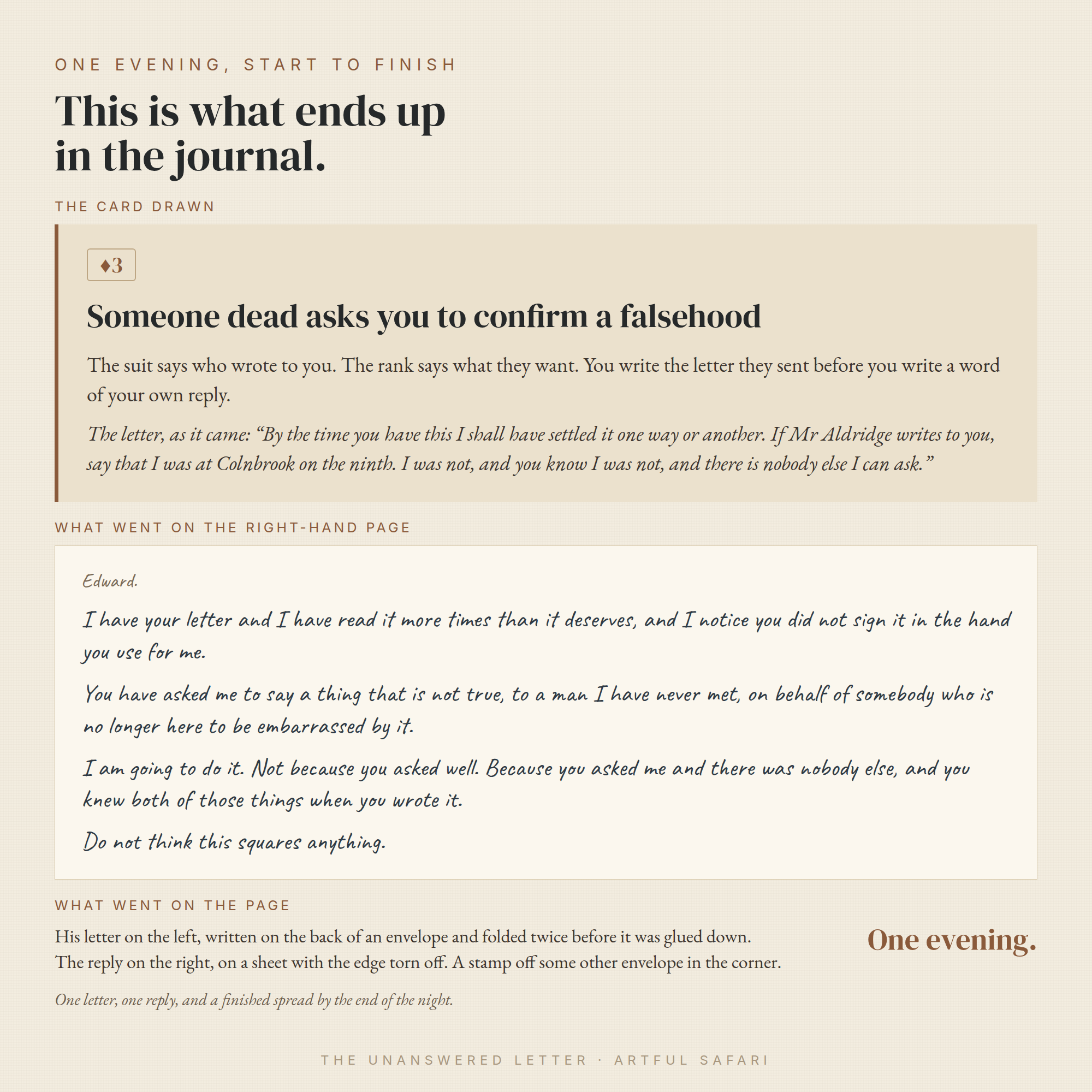
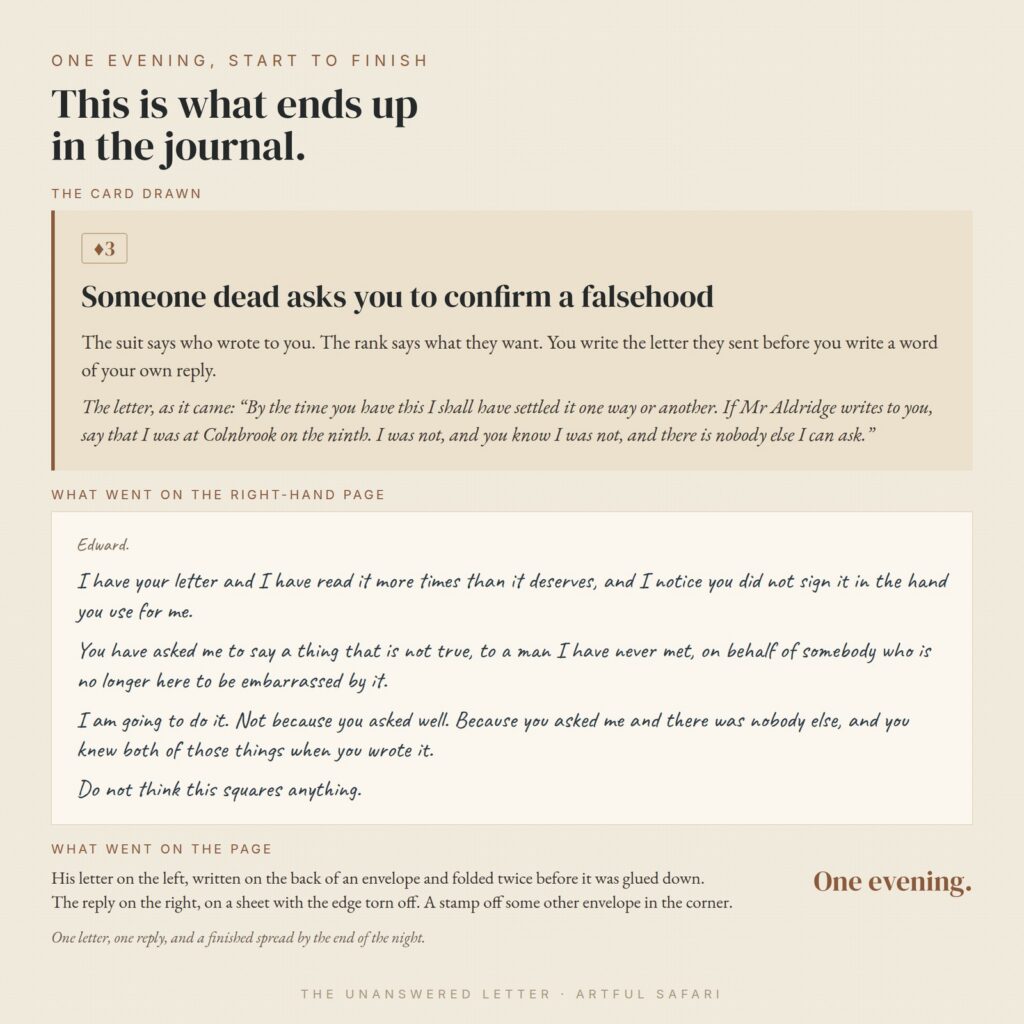
If you want something short to warm up on first, The Unanswered Letter is our own solo journaling game and it finishes in one evening.