
A solo TTRPG is a tabletop roleplaying game you play on your own, usually by writing what happens in a journal. It needs a journal, something to shuffle or roll, and a free evening. The eight below ask the least of a first-time player, and two of them cost nothing.
If you played round a table years ago and there is nobody left to play with, this is the shelf to look at. Nothing here needs a group or somebody willing to run the game for everybody else.
Table of Contents
What a solo TTRPG actually is
TTRPG stands for tabletop roleplaying game. Add “solo” and it means one player, one book of prompts and tables, and a journal that ends up holding the story.
There is no winning and no losing. You read a prompt, decide what your character does, then write down what happened in whatever way suits you. Some people write a page; some write four lines and stick a photograph next to them.
The craft side of this hobby has its own word for it. Journals4breakfast on YouTube coined RPJ, short for role playing journal, because “solo journaling roleplaying game” was too many words to say on camera. RPJ and solo TTRPG describe the same evening from two directions.
What you need for a solo TTRPG night
Every solo TTRPG on this list names its own kit, and the lists are short. A journal appears in all of them, a deck of ordinary playing cards in several, and six-sided dice in a few.
Two of the eight use something less common. Koriko asks for a tarot deck, and Ironsworn uses two ten-sided dice alongside one ordinary six-sided one.
You do not need a special journal. A composition book, a hardback you gutted, or the junk journal that has been sitting on the shelf all work, and the last one is how most of this community started.
How the eight are ordered
Easiest first. The first solo TTRPG here can be read and played in a single sitting; number eight is a 270-page book you will still be learning in a month.
For each game: what it is, what you need, how much writing it asks for, and who it fits. Where the publisher does not state a figure, I have left the figure out rather than guessed.
1. Alone Among the Stars, the smallest solo TTRPG here
Takuma Okada’s Alone Among the Stars is described by its author as “a tabletop roleplaying game about exploring space and experiencing wondrous sights”. It is listed as name-your-own-price, so you can take it for nothing.
The page says you need a standard 52-card deck and a six-sided die. The publisher’s own note on session length is “a few minutes”, which makes it the one to try if you want to know whether any of this suits you before you spend anything.
Best if you want one quiet page and then bed. It will not fill a whole journal on its own, so people chasing a long story tend to use it as a warm-up and move on.
2. Last Tea Shop Classic, a free solo TTRPG on one page
Spring Villager’s Last Tea Shop Classic puts you behind the counter of a tea shop “on the border of the living and the dead”, serving the recently deceased one last hot drink. The page states it “will always remain free”.
The kit list is printed on the page: an hour or so of quiet time, pen and paper, one or two six-sided dice, and tea, which it marks optional but recommended. Play runs until a visitor called the Veiled One arrives.
The whole game is conversation rather than adventure, and it is the shortest route into a solo TTRPG that still tells a story. A 16-page expanded edition is listed at $5.00 or more if you want the illustrated version later.
Watching one played is what makes it click for most people, so start with superbrainpanic’s playthrough above before you print anything.
3. Apothecaria, the solo TTRPG the crafters found first
BlackwellWriter’s Apothecaria is “a solo journalling RPG in which you take the role of a village witch creating potions for the unfortunate villagers, adventurers, and monsters that come to you for help”. It is listed at $13.00 or more.
You need a deck of cards with the jokers left in, a journal, and something to write with. No dice. The publisher calls it a long-term game and says it is more fun to take your time than to rush to the ending.
If your journal is already full of botanical papers and pressed leaves, the potion work gives all of it somewhere to go. Our full guide to playing Apothecaria as a junk journal goes through the setup page by page.
4. Koriko: A Magical Year, the one that says beginners are welcome
Jack Harrison’s Koriko: A Magical Year tells “the story of a teenage witch spending a year away from home in an unfamiliar city called Koriko”. Mousehole Press lists it at $18.00 or more.
You need the book, a tarot deck, a stack of dice and a journal. The story runs in six volumes, and the publisher says each volume takes an hour or two, which is the clearest time estimate any of these eight gives you.
Its own page says “you don’t need to have played a roleplaying game before”, and it is the only game here that states that outright. If you want the longer read, we have a post on keeping a Koriko journal you will actually finish.

5. Colostle, the solo TTRPG with cards instead of dice
Nich Angell’s Colostle is “a solo RPG rulebook that allows you to play a single player adventure campaign through the impossible and incredible world of the Colostle”, a world that is one endless castle. The digital edition is listed at £12.00 and the hardback at £35.00.
You need the book, a standard deck of playing cards and a journal. There are no dice in it at all, which is why it turns up whenever somebody says the numbers side of gaming put them off.
Its own page calls it “super simple, super creative” and “really easy to play, for all ages”. Explorers and map-makers get more from it than people who want conversation, and we have a step-by-step on starting a Colostle explorer’s journal.
6. Notorious, for a night with more game in it
Jason Price’s Notorious has you “play to tell stories of the Nomads; notorious bounty hunters who strike fear among the scum & villainy of the universe”. It is 76 pages and listed at $10.00 or more.
You need two six-sided dice, a character sheet and a journal. It carries two ways to play, an Arcade Mode and a Story Mode, and only the second one asks you to write.
That split is the point of it. If some evenings you want to roll and see what happens rather than write, this is the one that lets you do both, and our guide to journaling a bounty hunt covers the ledger side.
7. Thousand Year Old Vampire, the famous solo TTRPG
Tim Hutchings’ Thousand Year Old Vampire is “a solo roleplaying game of loss, memory, and vampires”, 188 pages, and you chronicle centuries of one vampire’s existence from the loss of mortality to the end. The digital edition is listed at $15.00 or more.
Play is prompt-driven with simple resource tracking, and the publisher says it can happen entirely on the character sheet or become a journaling activity, with both working equally well. The stated span is “a couple of hours or a couple of weeks”.
It is the one everybody names, and it is also the darkest thing here. Someone who wants a cosy evening will get more out of numbers two to five; someone who wants a story with real weight will get it from this.
Shut Up & Sit Down’s review shows what the pages look like in play, which answers the question the description cannot.
8. Ironsworn, the free solo TTRPG closest to a tabletop game
Shawn Tomkin’s Ironsworn puts you in “the dark fantasy setting of the Ironlands” as a hero sworn to perilous quests. The 270-page digital rulebook is free from Tomkin Press, along with a rules summary and printable cards.
You need one six-sided die and two ten-sided dice. It is built for solo, co-op and guided play, so the same book works alone or with the friends you used to play with.
This is the deepest solo TTRPG on the list and the one that will feel most familiar to anyone who has played round a table. It is also the most to read, so it fits better as your second or third game than your first, and we have a six-step walkthrough of a first Ironsworn session when you get there.
Dave Thaumavore’s review walks through how the moves and the oracles work, an oracle being the table you consult when you need the game to answer a question for you.
What one night of a solo TTRPG leaves behind
The thing nobody shows you is the page at the end. Here is one night from our own game, start to finish, so you can see the size of it.
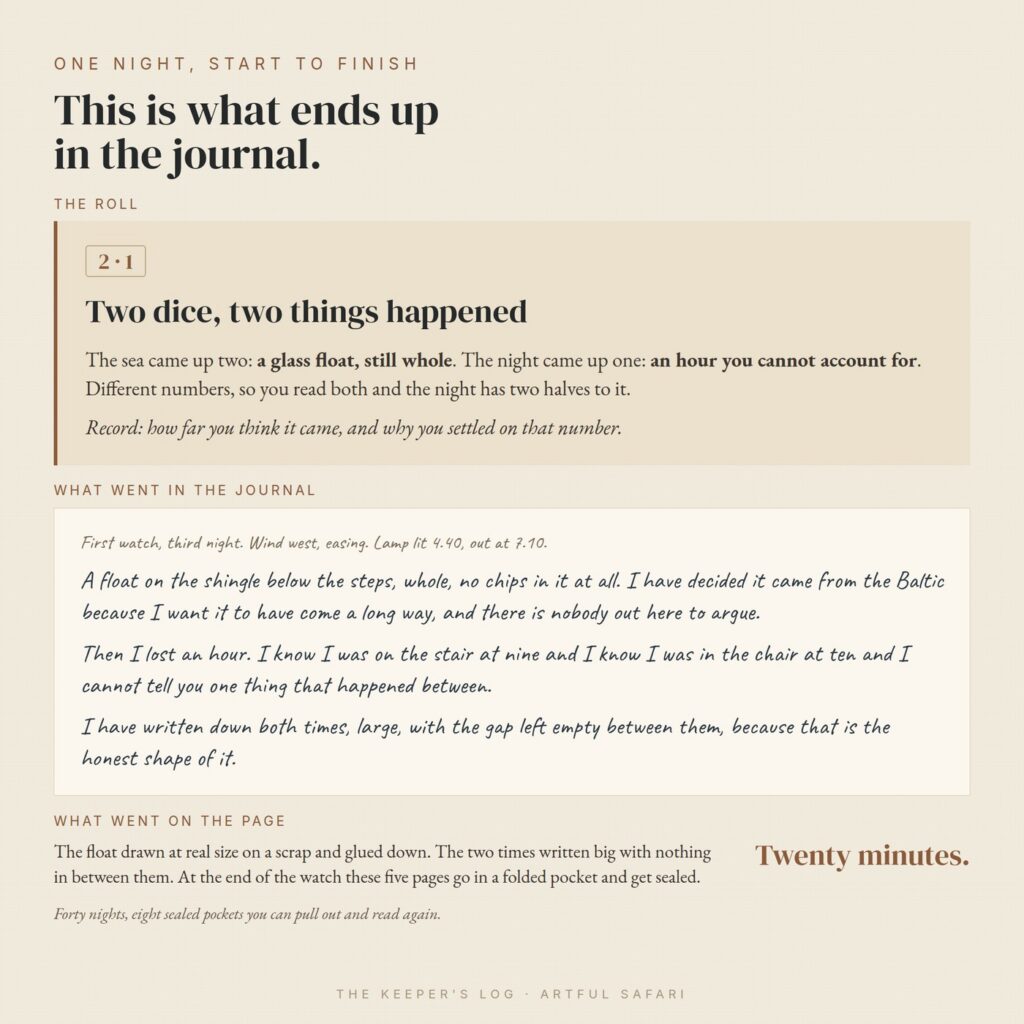
Twelve lines of writing and a scrap of paper stuck down. That is a full evening in most of these games. The book fills up at that rate without the evening ever turning into homework.
Solo TTRPG questions people keep asking
What is a solo TTRPG in plain words?
It is a book of prompts and tables you play by yourself, writing the results in a journal. TTRPG is short for tabletop roleplaying game, the kind played round a table with dice rather than on a screen. The solo version cuts the table down to one person, which is why the journal does the work the other players used to do.
Do I need dice to play?
Not always. Apothecaria and Colostle use a deck of ordinary playing cards instead, Koriko uses tarot cards, and several of the free games ask for nothing beyond a notebook and a pen. Where dice do appear it is usually one or two ordinary six-sided ones, the kind already in a board game box in the cupboard.
Do I have to be any good at writing?
No, and nobody else is going to read it. There is no plot hole for anyone to find and no handwriting to be marked. Plenty of people answer a prompt in four lines and spend the rest of the evening on the page itself, which counts exactly the same as three paragraphs.
I bought one and still have not started. Where do I begin?
Print the first two pages only, and answer the first prompt tonight. The usual sticking point is trying to set the whole journal up before play starts, which turns a game into a project. Our seven-night starter guide walks through the first week one evening at a time.
Which one should I pick if I have never played?
Take Alone Among the Stars or Last Tea Shop Classic as your first solo TTRPG, because both cost nothing and you will know within an evening whether the format suits you. If it does, Koriko is the one whose publisher says outright that no previous experience is needed. Our wider solo RPG starter guide covers the same ground for the non-tabletop crowd.
Can I use my junk journal for this?
Yes, and a junk journal is where most of this community keeps a solo TTRPG. It already has the pockets and tuck spots where the cards and the loose scraps end up living. Our complete guide to one quiet night covers the setup if your book is still empty.
Pick a solo TTRPG and start tonight
The cheapest way in is a free game, an hour after dinner, and the journal already on your shelf. Every one of these was built for a person sitting on their own.
If you want the papers and ephemera to go with the writing, The Crimson Parlour kit carries a thirteen-night mystery of its own.