
To make a junk journal for a solo journaling game, build it around the length of the game instead of the look of one page. Enough pages for a year of entries, tabs so you can find night twelve again, pockets that hold a card or a pressed leaf, and a back section you leave empty on purpose. Everything else is decoration.
That is a different brief from the books most of us already make. A themed junk journal is finished when it looks right. Make a junk journal for a game and the finish line moves to wherever the story ends, which might be forty nights away.
The crowd doing this calls the finished book an RPJ, short for roleplaying journal. The word was coined on camera by the YouTuber Journals4breakfast, who decided “solo journaling roleplaying game” was too many words and shortened it on the spot.
If you want papers that already match, and often ephemera too, our printable junk journal kits are made for this.
Table of Contents
Why an RPJ is built differently
The same sentence keeps turning up under craft channels on YouTube: I bought the game, I have a journal, and I still have not started. The book is usually the reason. Make a junk journal purely as an object and there is nowhere in it for the parts a game keeps asking for.
A game wants a place to write down who you are before you begin. It wants somewhere to keep the score of whatever you are tracking, be that coins, herbs or days survived. It wants to swallow a playing card without the page buckling.
So make a junk journal as four fixtures with space between them. It takes an afternoon, and almost nothing you do not already have: a blank book or a hardback you will gut, the papers in your stash, glue and scissors.
Shannon Green sets hers up inside an old chemical dictionary and films the whole build. Worth watching before you cut into your own:
How to make a junk journal for a solo game in 6 steps
Step 1: Count the nights before you make a junk journal
Open your game and find how long it runs. Most say it plainly in the first page or two, and the usual lengths are seven nights, forty nights, or a year of weeks.
Give each night a full opening rather than a single page. Forty nights becomes eighty sides, which is about a hundred-page book once you add the front matter and some spare. Doing this sum first is the one thing that stops a book running out in October.

Step 2: Make a junk journal out of the stash you already own
Now go and pull paper. Not new paper. The folders you bought in 2021, the offcuts you kept because they were too nice to bin, that pack of card you have moved house with twice.
Mix weights on purpose. Heavier sheets take glue, ink and a taped-down card without warping, while lighter sheets keep the book closing flat. A book that will not close is a book you stop opening.
One caution from the archivists. The Library of Congress advice on caring for paper says to keep sticky tape, rubber bands and acidic paper away from anything you want to keep, because the acid travels into whatever it is touching. For a book you will still be writing in next winter, that argues for acid-free card at the hinges and plain white PVA rather than a tape runner.

Step 3: Build the front matter the game keeps asking for
Before night one you need two fixed pages at the front. The first is your character: a name, what she does, what she wants, and a face if you have one to cut out or stamp.
The second is the place. A map, a plan of the house, a coastline, or a list of the rooms you have not opened yet. Games send you back to both of these constantly, so make a junk journal that keeps them where your thumb lands.
Step 4: Add pockets that take a card
Most of these games use ordinary playing cards or two dice to decide what happens next. Make a junk journal for one and you want somewhere to put the card you drew, rather than writing down what it was.
A folded envelope glued along three sides does it. So does a tuck spot, a library card sleeve, or a strip of paper glued at both ends. Put one on roughly every fourth opening.
Step 5: Make the running record findable
Somewhere in the book you are keeping a score that changes: supplies, coins, days, the people you have met. Give it a spread of its own near the front and tab it so your thumb finds it without looking.
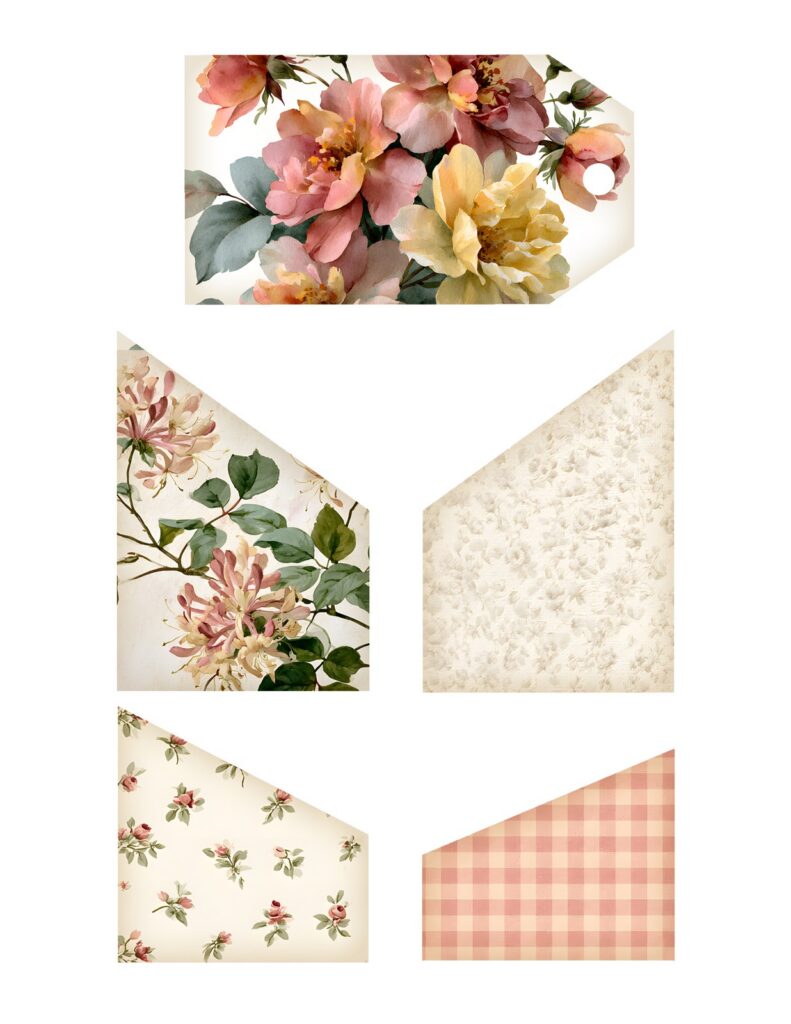
Ribbon, a folded strip of card, a torn tag glued to the edge, washi folded over the page. Tab the character page too. Make a junk journal without this and you will spend the first ten minutes of every night flicking.
Shannon Green tabs her book and coffee-dyes the pages in one sitting. The tabbing half is the part to copy:
Step 6: Leave the last quarter alone
Decorate the front third and stop. Leave the back plain, or bind it so you can add pages later with a few stitches or a ring.
Two things go wrong if you make a junk journal that is already finished on night one. Your story arrives somewhere you did not plan for and there is no blank paper to meet it, or the pages are so worked that writing on them feels like vandalism.

Your first night in the book
Open the game, read the first prompt, and answer it on the first opening. Write two sentences if that is what you have. Stick down whatever you drew, date the corner, shut the book.
That is a complete night. Nobody grades it and nobody reads it. Our guide to a solo journaling game’s first seven nights walks through a week of it.
Where people make it harder than it is
The commonest mistake is to make a junk journal so finished and so pretty that you never play in it. A book gets better with a game running through it, not before.
The other is going shopping. Half the pleasure people describe is raiding their own stash and finally spending what has sat in the craft room for years, so buying more rather defeats it. Read two pages of the rules, play one night badly, and go back to the rules when something confuses you.
Questions people actually ask
I have the game and I have a journal. How do I actually start?
Do step three tonight and nothing else: make the character page. It takes twenty minutes, it uses the game’s own questions as your prompts, and once a character exists in the book the first night has somewhere to happen. This is where most people stall, and it is nearly always the missing front matter.
How many pages does the book need?
Two sides per night, plus about ten for front matter and spares. Make a junk journal of around twenty-five pages for a seven-night game, or ninety for a forty-night one. If your book is smaller, use the game’s short version or plan a second volume.
Do I need dice?
Usually two ordinary dice, and a deck of playing cards will stand in for them in most games. Take the ace to six out of one suit, shuffle, and draw instead of rolling. Our card games are designed for a standard 52-card deck of playing cards, and plenty of other games need nothing but a notebook and a pen.
Do I have to be a good writer?
No, and the people doing this loudest are barely writing at all. Plenty fill their books with stickers, stamps and cut-outs and put one line underneath. Nobody sees the book unless you show them, so there is no plot hole to be caught out on.
I have never played anything like this. Is a junk journal the right book for it?
It is the best book for it, because you already know how to build one. Make a junk journal and you are already building pockets, tabs and layered pages, which are exactly the fixtures a game needs. If you want a refresher first, start with what a junk journal actually is.
Can I print my own papers for it?
Yes, and it is the cheapest way to get matched papers for a themed book. Our guide to printing junk journal papers at home covers the settings and the paper weights that behave.
Where to point the finished book
Make a junk journal this way and you then need a game short enough to finish inside it. Shannon Green keeps a running list of free ones, and there are dozens more on itch.io for nothing.
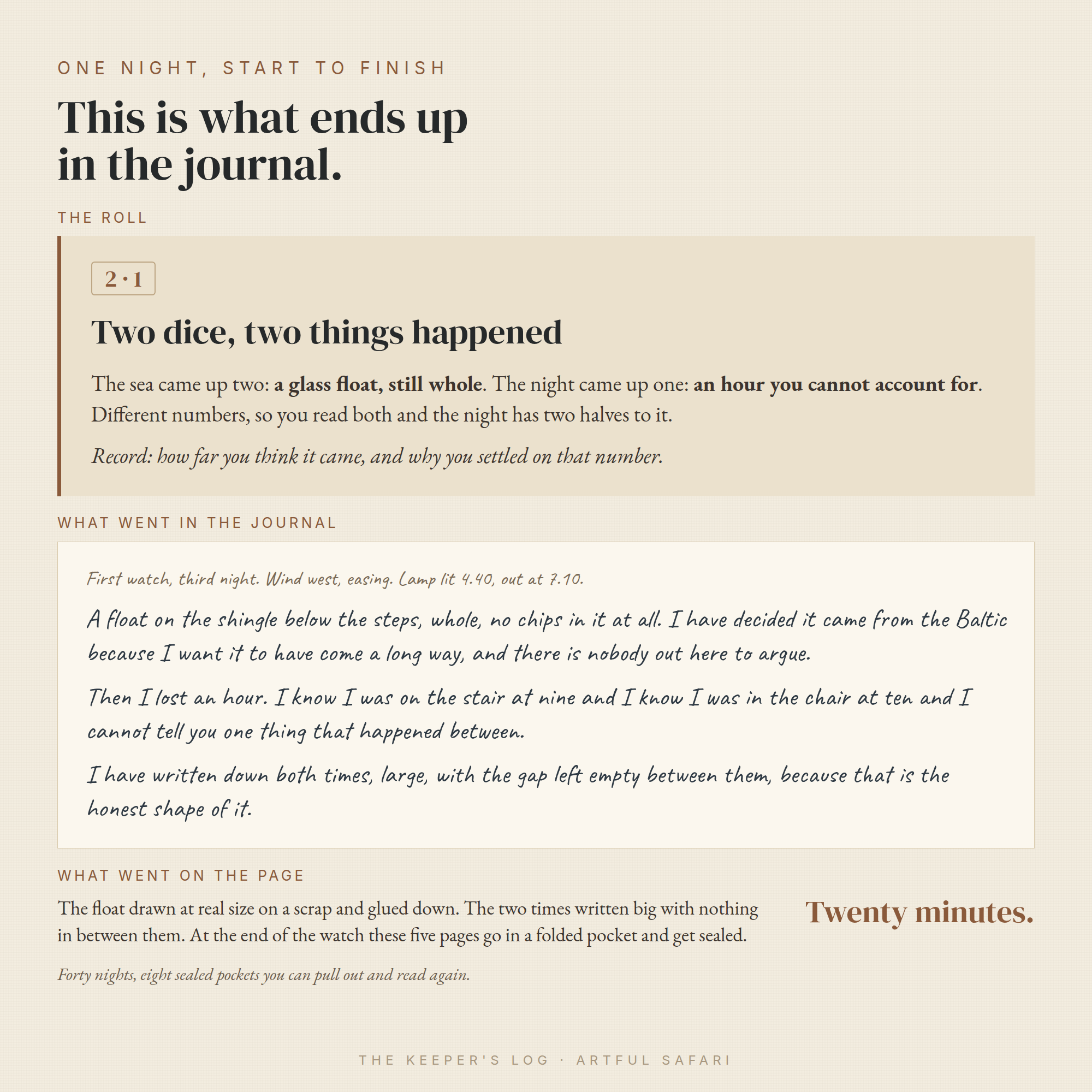
If you want one already sized to the book you have just made, The Keeper’s Log runs forty nights on two dice, which is the eighty-side book this article has been describing.