

A solo journaling game is a game you play alone, with a notebook, where the only thing you produce is writing. Nobody is playing against you and there is nothing to win. You draw a card or roll a number, the game tells you what happened, and you write down what your character made of it. That is the whole loop, and it has quietly become one of the most popular corners of tabletop gaming.
If you already keep a journal, you are most of the way there. What a solo journaling game adds is the thing a blank page never gives you: something to react to.
Table of Contents
What a solo journaling game actually is
The format grew out of tabletop role-playing games, but it stripped out almost everything people find intimidating about them. There is no group to organise a night around, and the rules usually fit on a page.
What is left is a prompt engine. A typical solo journaling game gives you a randomiser — most often a standard 52-card deck — and a table that maps each result to a situation. You draw, you read, you write. A session is usually one draw, and one draw takes about ten minutes.
The randomiser matters more than it sounds. Left to yourself, you write about the same three things forever. A solo journaling game keeps handing you material you would not have chosen, which is exactly why the writing gets interesting.
What you need to start
Almost nothing, which is the appeal.
- A deck of playing cards, or dice if the game asks for them
- Something to write in — a notebook, a junk journal, a document on your laptop
- Something to write with
- Ten quiet minutes
That is genuinely the whole list. Some games add printable components — a map, a character sheet, cards to cut out — but a solo journaling game that requires a shopping trip before you can start has got the format wrong.
Your first 7 nights, one at a time
Most people stall on night one because they are waiting to feel ready. Here is what the first week usually looks like instead.
Night 1 — make somebody up
Draw two or three cards and let them tell you who you are playing. Where they came from, what they carried with them, what they are afraid of. Write four sentences. Do not design a person; discover one.
Night 2 — write badly on purpose
Draw one card, read the result, write half a page without editing. The first entry in any solo journaling game is always the worst one, and getting it over with is the entire task.
Night 3 — add a physical thing
Stick something in. A ticket, a leaf, a scrap of patterned paper. This is where journalling and gaming meet, and it is the point at which the book starts feeling like an object rather than a notebook.
Night 4 — let it be boring
Some draws are quiet. Write the quiet one anyway. A year of only dramatic nights reads like a soap opera, and the flat entries are what make the loud ones land.
Night 5 — go back and read night 2
You will notice a thread you did not plant. Follow it. This is the moment most people realise a solo journaling game is not a writing exercise but an actual story.
Night 6 — skip a night
On purpose. The format survives interruption; that is its advantage over a daily-streak app. Come back on night seven and nothing is broken.
Night 7 — look at the spread
Seven entries is enough to see a shape. Some people find they want to make the pages beautiful. Some find they only want to write. Both are correct, and knowing which one you are shapes every game you pick from here.
Why a solo journaling game beats a prompt list
Prompt lists are the obvious comparison and they fail in a predictable way. You read down the list, pick the one you like, and end up writing what you already wanted to write. A solo journaling game removes the choosing, and the constraint is what makes it work.
The second difference is that a game has an ending. A prompt list runs until you get bored. A game with 52 cards runs for 52 nights and then stops, and finishing something is rarer and more satisfying than most people expect.
How to pick your first solo journaling game
The category is large now and the quality is uneven, so three questions save most of the wasted money.
How long is a full game? Look for a stated length — 52 nights, 30 entries, twelve chapters. A game with no defined ending is a prompt list wearing a costume, and you will drift away from it in week two.
What does it ask you to do each turn? Some games want a paragraph. Some want a page. Some want you to draw. None of those is better, but the one that matches how you actually like to spend ten minutes is the one you will finish.
Does it assume you have played before? A good solo journaling game for a first-timer includes a walkthrough of the opening session and at least one worked example of a finished entry, so you can see what “right” looks like rather than guessing. If the rules jump straight to the prompt tables, it was written for people already in the hobby.
Three mistakes in a first game
- Treating it as homework. Ten minutes is a real session. A solo journaling game that has to be an hour will be skipped.
- Buying a beautiful notebook first. The good notebook makes the first entry harder. Use a rough one.
- Picking a game that destroys your work. Some designs ask you to tear out or black over pages you made. If you have spent half an hour on a spread, that is not tension, it is a reason to quit. Check for this before you buy.
Putting it together: one worked example
Here is how the pieces fit in practice. Folklore Forest is a solo journaling game about a wood that is forgetting itself. You have inherited the last keeper’s notebook, and you walk out at dusk with a pencil.
The suit of the card decides which part of the wood you walked into. The number decides what you found — a stone that is always warm, a doorstep with no house, a saucer of milk that hasn’t turned. You write the entry in your own words, and then every entry ends with something to make: mount the specimen, tape the edge, draw the thing badly and label it anyway.
One night, start to finish
Descriptions of the format only go so far, so here is a single night in full. The card was the three of diamonds. Diamonds is the Shadowed Path, which made the entry The Lantern Ahead: there is a light on the path in front of you moving at exactly your pace, and when you stop it stops, after a moment with hesitation in it. Underneath, the book asks one question. Did you call out, and what did you say.
What went into the journal, unedited:
4th of the Turning. The Shadowed Path.
There was a light out ahead of me again. Fourth time. I have stopped writing “again” as though it means something.
I walked faster to see what it would do and it walked faster, and then I stopped and it took about a second and a half to stop too. That second and a half is the whole thing. A light doesn’t hesitate. A person hesitates.
I said “you can walk with me if you like.” Out loud, on an empty path, at half nine at night, like an idiot.
It went out. Not moved off. Went out. I don’t think I frightened it. I think I embarrassed it.
Then the page. The darkest paper in the drawer went down as the whole background, one thumbnail of gold low and left of centre stood in for the lantern, and the writing went over the top in white pencil. Nothing else. The whole night took nine minutes.
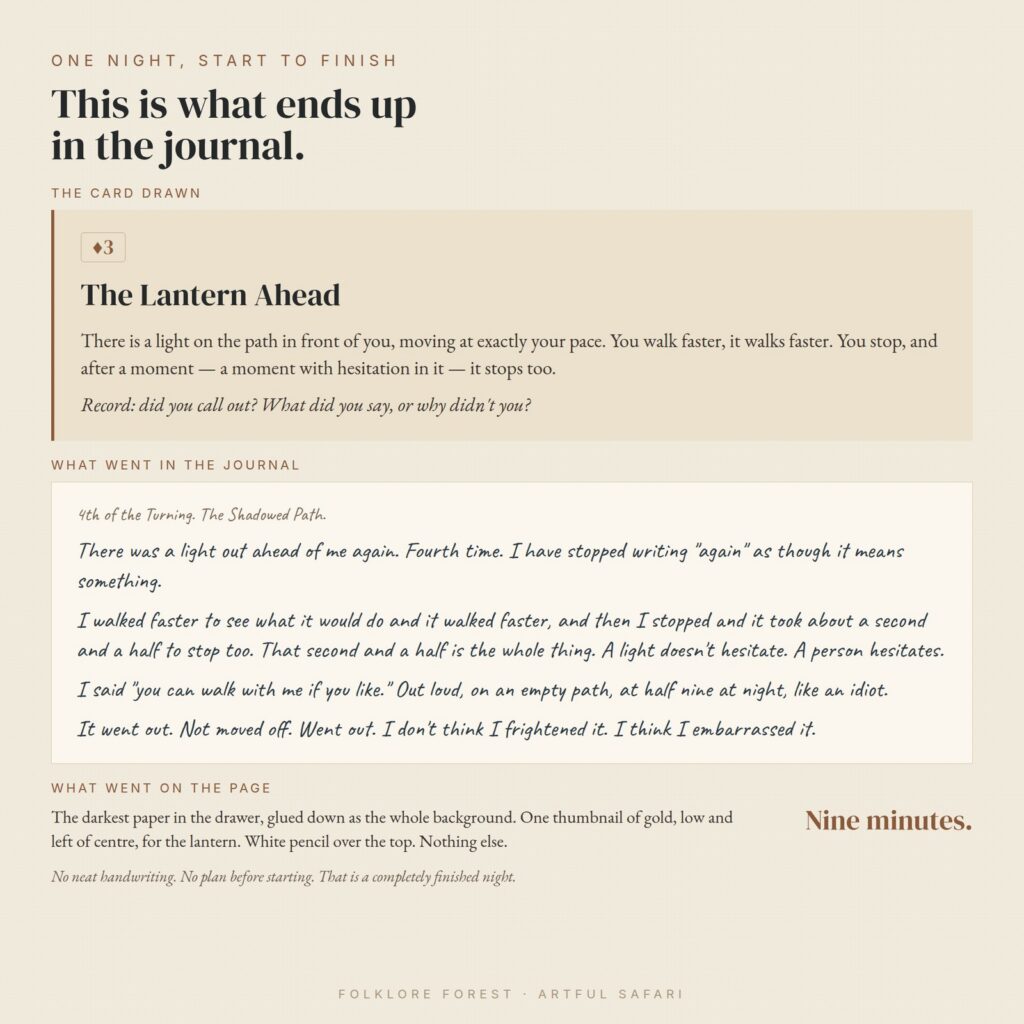
Notice what did not happen there. No neat handwriting. No plan for the page before it was started. No attempt to write well. Four short paragraphs, one of them a joke at the writer’s own expense, and that is a completely finished night. This is the part most people are trying to picture before they start, and seeing one real entry usually settles it faster than any amount of explanation.
That last instruction is what separates this kind of solo journaling game from a pure writing one. The year leaves you holding a book rather than a folder of notes. If you want to see how a woodland spread comes together physically, our guide to building a woodland junk journal covers the layering, and if the whole junk-journal side is new, start with what a junk journal actually is.
Where to go from here
Pick something with a defined length, play it badly for a week, and see whether you are a writer who likes making pages or a page-maker who likes writing. A solo journaling game is cheap to try and impossible to fail at, which makes it one of the few hobbies where the sensible move is simply to start tonight and find out.
Seven nights is enough to know. Fifty-two is enough to have made something.