
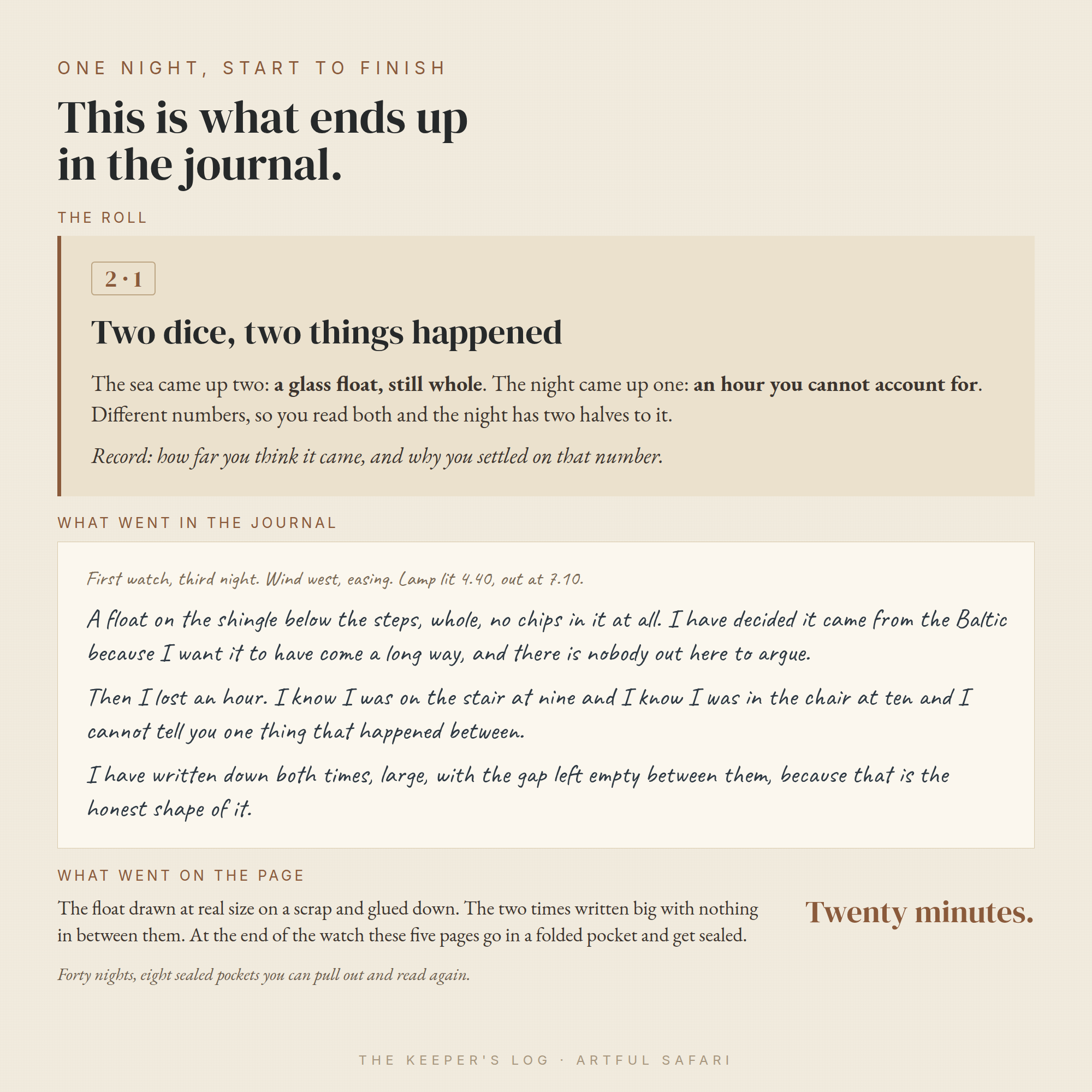
A journaling game gives you a prompt, usually off a card or a die, and you write down what happened to a character you made up. You keep the writing in a notebook you own. Nobody is playing against you and there is nothing to win, and the rules are short enough to learn on the first night.
That last part is the bit people do not believe until they see it. The word most of these games carry on the cover is “roleplaying”, and for a lot of us that means a table of teenagers with strange dice in the early eighties.
What actually arrives is a book of prompts. The rest is a notebook you already have.
The crafters who found this in the past two months call it an RPJ, short for role playing journal. The word was coined on camera by the YouTuber Journals4breakfast, who took one look at the four-word official name and decided it was too many words. Her video is the fastest way to understand the appeal:
Table of Contents
What actually happens in a journaling game
You draw a card, or roll a die, or turn to the next numbered page. The game reads back a situation. You write down how your character met it, and then you close the book until tomorrow.
Some hand you the situation as a card like the one above. Others give you a table of numbered results and a die to pick one. We pulled the parts apart in the complete guide to one quiet night.
How to choose your first journaling game
Most people who abandon a journaling game abandon it after printing, not after playing. Every entry below answers the same three questions, because those are the three that decide it: what it is, what you need, and how much writing an average night asks for.
The seven below are ordered by how little stands between you and your first page. The first two ask almost nothing. The last runs for a year.
1. Alone Among the Stars
What it is: you are a lone explorer visiting planets nobody has named, and each planet gets one entry. The whole ruleset is about four pages.
What you need: a pack of playing cards, one ordinary six-sided die of the kind in a board game box, and a notebook.
How much writing: as little as a few lines per planet. Takuma Okada says a game runs from a few minutes to several hours, so this is the journaling game you can reach a real ending in tonight. It is name your own price, so the download works with the price set to nothing.
2. The Sticker Game
What it is: a story told through 41 short audio tracks, where you answer with stickers rather than sentences. Cassi Mothwin built it as an audio drama you play along with.
What you need: headphones, a notebook, and the stickers already in your drawer. The rules ask for more than twenty and then tell you not to go and buy any, which is a sentence worth reading twice.
How much writing: barely any, which is the point. It runs to roughly one to two hours, making it the other journaling game here you can finish in an evening. It is $12.99 USD or more.
3. Apothecaria
What it is: you are the witch in a small village and people keep turning up with ailments. You gather things, you brew something, you write down whether it worked. Anna Blackwell describes the tone as Studio Ghibli by way of Stardew Valley.
What you need: a pack of playing cards including the jokers, a journal, and something to write with.
How much writing: a session runs about half an hour, and it is built to be played over months rather than finished. Shannon Green set hers up inside a gutted hardback and filmed it:
It is $13 USD or more. We have seven ways to keep it as a junk journal if the herbal and the pressed cuttings are the part you want.
4. Colostle
What it is: a journaling game set inside one endless castle, and you walk through it room by room. Nich Angell’s own words: a solo rulebook that “throws prompts and moments at you, and you must decide how your character reacts while recording your adventures in a journal”.
What you need: the rulebook, a pack of playing cards, and a blank journal.
How much writing: one card, one room, one entry, for as long as you keep drawing. The rulebook is at colostle.com, and our six steps to a first explorer’s journal covers the setup.
5. Notorious
What it is: the journaling game here that is not fantasy at all. You are a bounty hunter taking a contract in the middle of a war between six factions, and it reads like a western that happens in space.
What you need: two ordinary six-sided dice and a notebook. That is the entire kit.
How much writing: your choice, because Jason Price built two ways to play it. There is a quick mode and a slower Story Mode for people who came for the journal. It is $10 USD or more, and we have six ways to journal a bounty hunt.
What one night of a journaling game looks like on the page
Almost nobody shows this part, which is why it stays mysterious. Here is one real night: the card that came up, and what went into the journal underneath it.
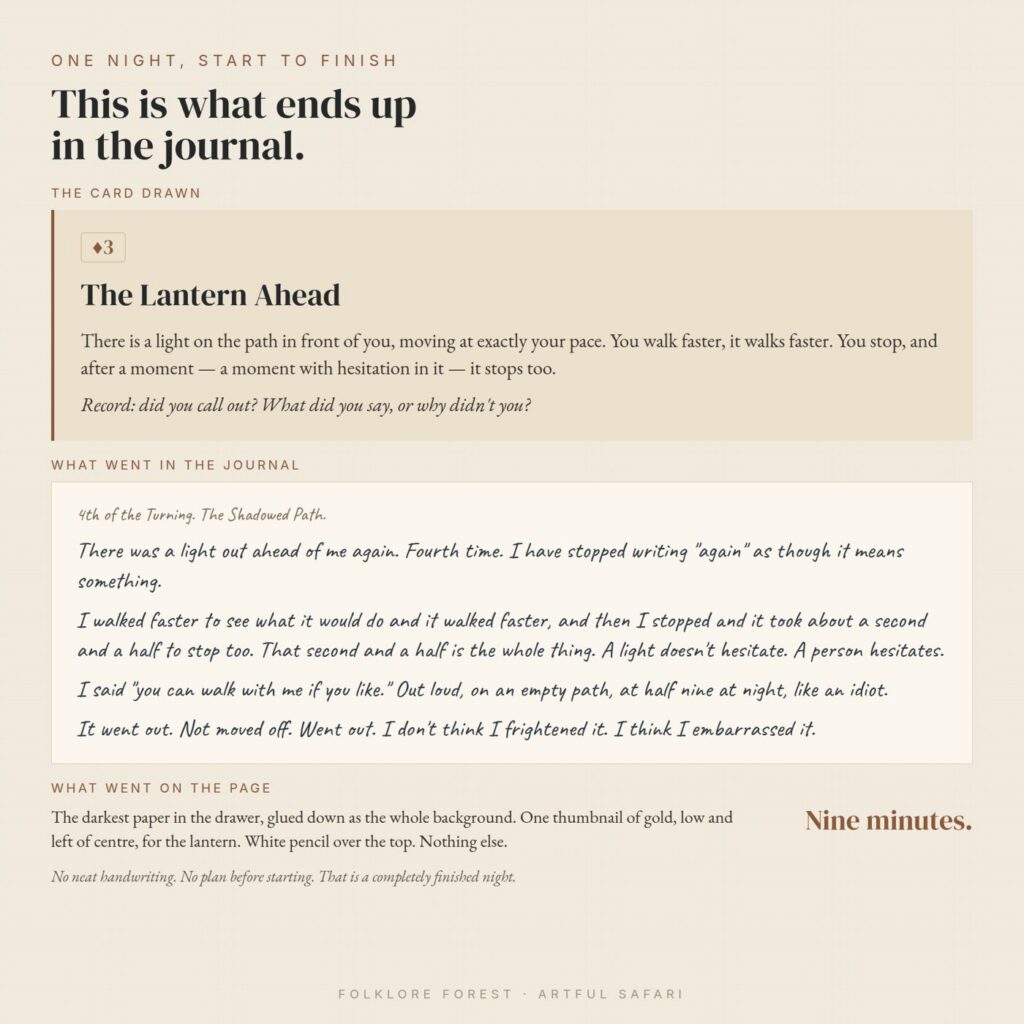
Look at what is missing. There is no essay and no plot worked out in advance, just five short paragraphs and a piece of dark paper glued down behind them.
6. Ironsworn
What it is: you swear a vow you cannot easily keep and then go and keep it, in a cold landscape of forests and violent seas. It is the heaviest book here at 270 pages, and it is free.
What you need: one ordinary six-sided die and two ten-sided ones, plus a notebook. Ten-sided dice come in any cheap dice set.
How much writing: more than the first five, because vows carry across sessions and you need a record. This is also the only journaling game here you do not have to play alone: Shawn Tomkin designed it for solo, co-op and guided play. Our six steps to a first session walks through the first vow.
7. Koriko: A Magical Year
What it is: a teenage witch spends a year away from home in an unfamiliar city. Jack Harrison wrote it as a slow year across six volumes, with a pause between each to write a letter home.
What you need: a tarot deck, some dice and a journal. It says outright that no previous experience is needed.
How much writing: the most here. Each volume takes one to two hours and a full playthrough runs six to twelve, which makes it the journaling game that genuinely fills a notebook. It is $18 USD or more, and we have five ways to keep a Koriko journal worth finishing.
Where to find a free journaling game
Two on this list cost nothing and there are dozens more. Most live on itch.io under name-your-own-price, so the download works with the price set to zero and the creator takes whatever you pay later.
Shannon Green went through twelve free ones in one video and showed how to print them so they fold into a booklet rather than a stack of loose sheets:
Wikipedia’s entry on solo role-playing games covers where all this came from, if you want the history before you spend anything.
Journaling game questions people actually ask
What is the journaling part, exactly? Am I writing like a novel, or making notes?
Either, and most people end up doing both in the same book. Plenty of entries in a journaling game are a paragraph written as the character, in first person, the way a diary reads. Others are a bulleted record you can look up in three weeks.
Is there a journaling game with less writing and more game?
Yes, and The Sticker Game is the clearest one, because you answer with stickers rather than sentences. Notorious has a faster mode built in for the same reason. As a rule the dice-driven games ask for less writing than the card-driven ones, and both ask for less than a season-and-letter game like Koriko.
Can I draw, glue and decorate in it, or does it have to be words?
Decorating is how most of this audience plays and no game forbids it. People press cuttings into Apothecaria and glue printed game pages into gutted hardbacks. If you already junk journal you are ahead of someone arriving from tabletop gaming, because the hard part for them is making the book look like anything.
Do I have to play a journaling game on my own?
No. Ironsworn runs the same rules for one player, a pair, or a group with someone moderating, and Alone Among the Stars is written for one or more players. The rest assume one person because that is what they were designed around, though nothing stops two people keeping parallel journals from the same prompts.
Is there one long enough to fill a whole notebook?
Koriko is the one here built for it, at six volumes and a whole in-game year. Apothecaria also runs long, because it is written as an ongoing village rather than a story with an ending. Either will still be going next spring.
What does a journaling game cost?
Free to about eighteen US dollars, and two on this list cost nothing at all. The very small ones sold on Etsy and itch.io tend to sit nearer five. The notebook is usually the bigger spend, and plenty of people use one that was already in a drawer.
Which one to open first
If you have never played anything, set Alone Among the Stars to nothing and write one planet tonight. If the book is the draw rather than the story, start there instead and read how to build one for a solo game, or work through your first seven nights, one at a time. Both routes end in the same place, which is an RPJ you keep.
And if a journaling game about a lighthouse keeper on a coast that keeps sending things ashore sounds like your kind of thing, The Keeper’s Log is ours: two dice, forty nights, and every rule on page two.