A nature journal is the easiest kind of journal to start and the hardest to keep filling. The first page goes in on a good day with a leaf and a few notes. By the third week the pages feel thin, and the book sits on a shelf.
This guide is for the second problem. Here are six ways to fill a nature journal page so it holds something real, whether you keep it on paper or in a digital scrapbook app.
1. Start the nature journal page with a surface, not a subject
Most people open a nature journal and look for something to record. Try the opposite. Choose the surface first, and let it tell you what belongs on it.
A cream page with pressed fern fronds near the edges leaves the middle open for one photo and a few lines. A plain white page asks for everything, which is why it stays blank. A textured background does half the work before you add a word.
2. Keep one specimen per page
The pages that get finished are the ones with a single subject. One oak leaf, one feather, one acorn cup from the walk home. A crowded page is a page you will not want to open again.
If you collect more than one thing on a walk, give each its own page. A nature journal with twenty slim pages reads better than one with five overloaded ones.
Pairs work too, if they belong together. A feather and the leaf it landed on make one page, because the second thing explains the first.
3. Write the place, the weather and the date first
Before you describe the specimen, put down where you were and what the sky was doing. These three small facts take a few words and make the page useful later. They are also the easiest way to start when you have nothing to say yet.
Plant collectors work this way too. A herbarium sheet is only useful if it records where and when the plant was found, and a nature journal page works the same way.
Add one sensory detail if you can. The smell of wet bracken or the sound of rooks in the oak is the line you will be glad of in a year.
4. Learn two or three names, then stop
You do not need to identify everything. Pick the fern you keep passing and learn what it is called. The Royal Horticultural Society keeps a useful page on garden ferns if you want a place to begin.
Write the name small beside the specimen. A page with a name on it is a page you can find again, and each name you learn makes the next walk more specific.
5. Mix real and digital pieces
A pressed leaf cannot go flat in a phone app, and a photograph cannot be glued into a field notebook without printing it. Digital pages let you do both on one spread. Photograph the real leaf, set it on a botanical background, and add your notes in a text box.
This is also how to avoid damaging anything fragile. The leaf goes back in its envelope while the page you made of it stays in the album. If you want more on the digital side, our guide to building a woodland junk journal covers layering in more detail.
Layout matters less than people think. Put the specimen where your eye lands first, keep the writing in one block, and leave a margin. A page that breathes looks finished even when it is simple.
6. Let colour hold the pages together
A nature journal looks like one book when the pages share a palette. Cream, oatmeal and sand with a little sage and dove blue will go with nearly everything you pick up outdoors. Bright backgrounds fight with the muted colours of dried leaves and feathers.
What to carry so the nature journal page gets finished
Keep the kit small enough that you never leave it at home. A phone for the photograph, a small envelope for anything fragile, and a note app open for the place and the date. That is a complete field kit for a digital nature journal.
Take the photograph before you pick anything up. Shoot the specimen where it grows, then one close picture of the detail you liked. Two photographs are plenty, and choosing between them later is part of the fun.
When you get home, do the page the same day. The weather, the name and the sensory line fade quickly. A page made while the walk is still fresh takes less effort and says more.
Putting it together: a nature journal page from one paper
Here is how the six ideas come together on a single page. I will use the Small Wild Things botanical papers as the example, because they were designed for exactly this job.
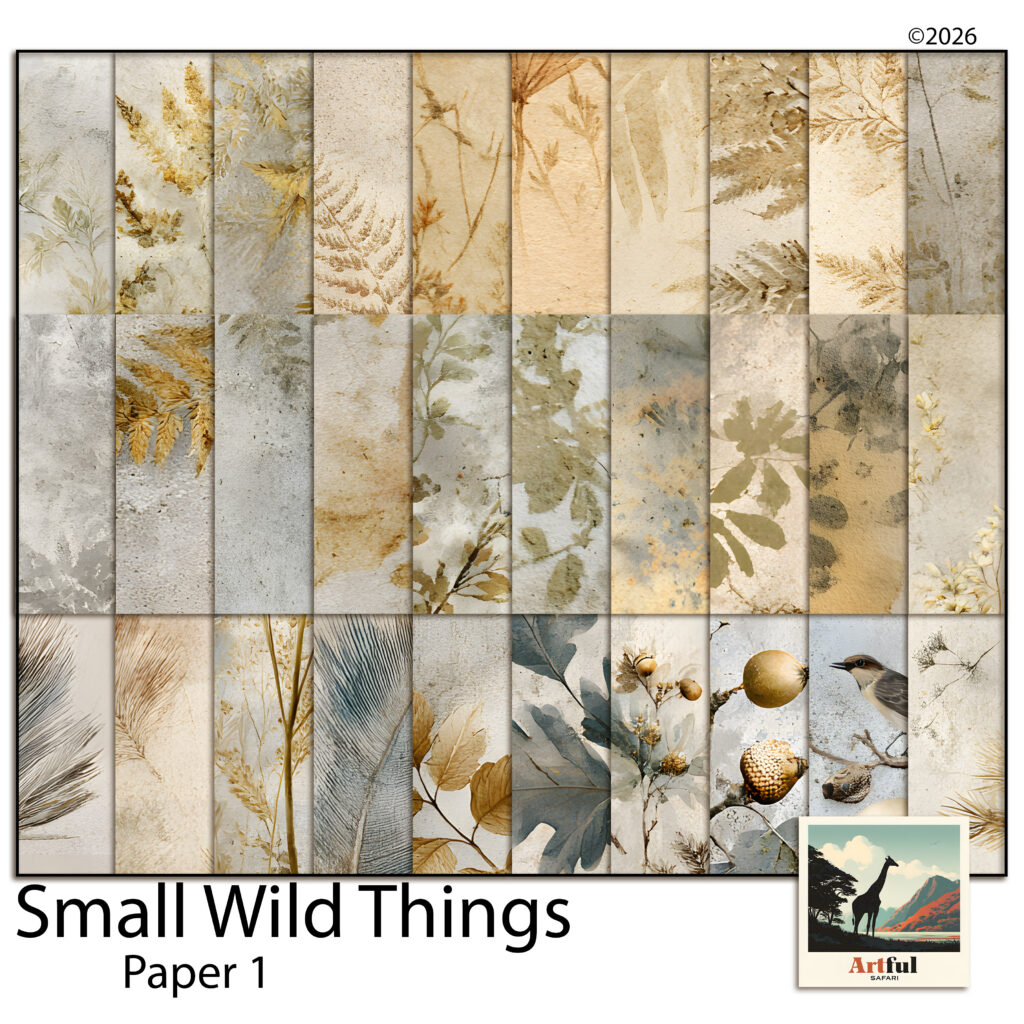
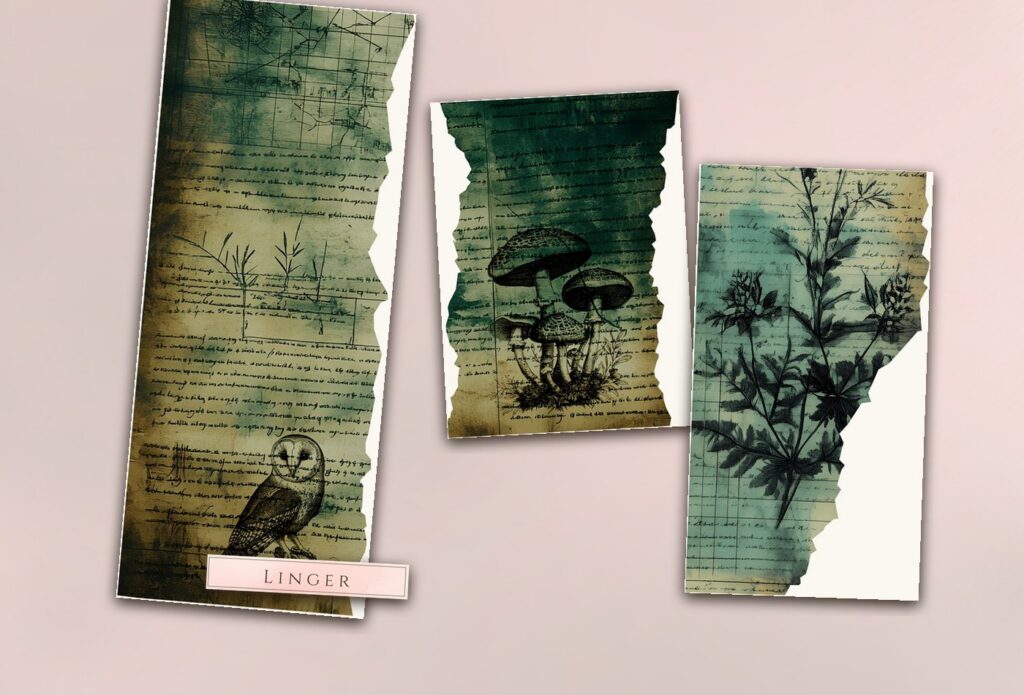
Pressed fern, feather and oak papers from the Small Wild Things collection.
The Small Wild Things botanical background papers are a set of 30 full 12 x 12 in pages of pressed ferns, grasses, feathers, oak leaves and pinecones. The detail sits toward the edges and the centre stays open. That open centre is where your photo and your three lines of notes go.
Pick the paper with oak leaves and acorns for an autumn walk. Choose a soft fern paper when the weather was grey and you only brought home one frond. Drop your photograph in the middle, add the place, the weather and the date, then write the one name you learned.
Because the papers share a palette, thirty pages in a row will still look like one nature journal. That is the quiet advantage of working from a set rather than choosing a new background every time.
Several of the papers in the set carry a small bird or a cluster of mushrooms in one corner. Those suit a page about a woodland edge, where the creature is part of the story and the specimen is not the only point of interest.
Others are almost bare, with only soft washes of colour. Use those under a page that already has a lot going on, such as a spread with three photographs and a long entry.
Keep the next nature journal page small
You do not need to fill a page every day. A nature journal built from short, finished pages beats a long one full of good intentions.
Season by season, the pages add up to a record of one place: the first fern unrolling, the dry grasses in late summer, the oak leaves going to oatmeal and ochre. That record is the reason to keep a nature journal at all, and it only exists if the pages are easy enough to finish.
Next time you are outside, pick up one thing. Give it a page, a place, a date and a name, and close the book.
Give each entry in your solo murder mystery journal two short headings: What I found and What I think it means. Write the clue under the first heading and your guess under the second. Keep any suspect sheet supplied by your game beside the journal, and update it when the rules tell you to.
Here is a page you can try before you buy a game. You need a notebook and a pen. The example is a made-up writing exercise for this guide; it is not a scene or clue from The Crimson Parlour.
To see The Crimson Parlour next to our other games, browse the solo journaling RPGs.
Try a clue and a guess on one page
Use this fictional starting point: someone has left a wet coat beside the study door. A guest says they have spent the whole evening by the fire.
Write these headings on a blank page, then add your own answers. Leave space beneath the guess for a later note.
Entry: The coat by the study.
What I found: A wet coat lay on the chair by the study door. One sleeve had been tucked out of sight.
What I was told: The guest said they had stayed by the fire all evening.
What I think it means: Perhaps the guest went outside. I do not yet know who owns the coat.
Still to ask: Whose coat is it?
Stop when you have written one guess and one open question. That is the end of this exercise. The coat alone does not establish who left it there, when it got wet or whether its owner committed a crime.
If you want to add to the scene, invent a reply from the guest. Keep it under “What I was told” so you can still see which details came from the scene and which came from a character.
Let the game decide who is cleared
When you use this page layout with a published game, follow that game’s rules for clues and suspects. A suspicious detail you add while writing should not change a card result.
The Crimson Parlour shows why this matters. Its rules count a person as innocent when you find one of their cards. The murderer’s cards are sealed in an envelope at setup, so those cards cannot turn up during the search.
A character can still have a secret after they have been cleared. Keep that secret in your story, but leave the cleared result on the game’s suspect sheet. In The Crimson Parlour, that sheet is called the Register.
There is an exception to watch for: an ace ends the night without clearing anyone. Follow the ace’s instructions in the game book. Do not cross out a face merely because you turned a card.
Make your notes easy to find again
Number each journal page as you use it. When a person appears again, add a note such as “Earlier entry: page 4.” This works in a bound notebook; you can leave the pages where they are.
Keep the game’s required records in their stated places. Use your journal’s extra notes for details you want to return to: a name, a remark, a room or an unanswered question.
If a new clue changes your guess, date a new note beneath the old one. For the coat exercise, you might write: “I now know the coat belongs to the gardener. My first guess about the guest needs another reason.” This is an invented continuation, not a game result.
To add paper scraps, leave the headings and page numbers uncovered. Put a small scrap beside the entry, or draw a border around the clue. Read the words once more before you glue anything down.
Read your notes before the ending
When your game asks for a final choice, turn back to your notes. Which details came from the game? Which were statements by characters? Which were your own guesses?
Write your choice using the game’s ending instructions. In The Crimson Parlour, you write the accusation before you look through the unused cards or choose to open the sealed envelope. Your journal records why you chose that name.
Choose a mystery to put in your journal
The Crimson Parlour standalone game is a solo journaling murder mystery set in a snowed-in Victorian house. It uses playing cards and a journal, with thirteen nights in its story.
The standalone purchase is a digital download of the game and printable components. Bring a printer, a deck of playing cards, a journal, a pen, scissors, glue and your own paper scraps. The matching decorative papers and ephemera are sold in a separate bundle.
Most Halloween scrapbook ideas assume orange and black. That works for a haunted house party, but it swamps a photo of a toddler in a pumpkin costume. The page ends up louder than the child.
These Halloween scrapbook ideas go the other way: plum, lilac, sage and apricot, cute pumpkins instead of skulls, and a page that still says October at a glance. Seven of them, then a worked example at the end.
Why pastel Halloween scrapbook ideas work for family photos
Costume photos are already busy. There is a hat, a cape, a bucket of sweets and usually a doorstep lit by a porch light. A saturated orange background competes with all of that, and the face gets lost.
Pastel grounds do the opposite. A dusty lilac or a pale sage sits back behind the photo, so the costume carries the colour and the paper carries the season. It also helps if you keep one album for the whole year: October pages in muted colours sit comfortably next to September and November instead of jumping out of the book.
What still makes a page read as Halloween
You don’t need orange everywhere for a page to say Halloween. Three motifs do most of the work: a pumpkin, a witch’s hat and a small ghost. Put one of them near the photo and the season is clear, even on a lilac page. The pumpkin has been Halloween shorthand for so long, back to the carved jack-o’-lantern, that even a pale sage one reads as October.
1. Put a plain wash behind the photo
Start with the plainest paper you have and put the photo straight on it. A watercolour wash with no print on it gives the photo somewhere quiet to sit. Save the patterned paper for the page behind the wash, or for a strip along one edge.
This one change clears up most crowded Halloween pages. If you only try one of these Halloween scrapbook ideas, try this one.
2. Choose one accent colour and repeat it three times
Pick the colour that shows up in the costume. If the cape is purple, pull plum into a title, a tag and one element. Three small repeats tie the page together better than one large block of colour.
Apricot is a good second choice because it is the pastel version of pumpkin orange. It keeps the Halloween hint without the glare. For more on pairing muted tones, there is a longer guide to sage green colour pairings that applies here too.
3. Let the pumpkins carry the theme
Most good Halloween scrapbook ideas start with a pumpkin. One good pumpkin cluster at the base of a photo does more than ten small ones scattered around it. Anchor the cluster to a corner so it looks like it is sitting on something. A garden gate or a shelf behind the pumpkins gives them a place to be, which reads as a scene rather than stickers.
Pumpkins wearing witches’ hats are the easiest way to keep things cute. They are a joke a small child gets straight away.
4. Use word art as the title, not as decoration
Word art is where a lot of Halloween scrapbook ideas go wrong, because it is tempting to use several. A phrase like “Too Cute to Spook” or “My First Halloween” works best as the page title, placed close to the photo and slightly overlapping it. Keep it to one phrase per page. Two titles fight over which one is the headline.
For a first Halloween, the date matters more than a clever line. Put the year on a small tag under the title so the page still makes sense when the child is twelve.
5. Keep the ghosts small
Ghosts are where cute Halloween scrapbook ideas can tip into creepy. They turn scary when they are big and close to the edge of the page. Small ghosts floating in a corner, or peeking out from behind a photo, stay friendly. Two or three at different sizes give the page some depth.
The same goes for bats. A trio flying out of one corner looks like movement. A dozen spread across the page looks like wallpaper.
6. Build a two-page spread from one paper
For a trick or treat night with lots of photos, use the same patterned paper on both pages and change only the wash behind each photo. The reader sees one evening across the spread, and each photo still gets its own quiet space. Among these Halloween scrapbook ideas, this is the one that makes an album look planned.
Halloween pages are the ones people forget to journal on, because the photos seem to say everything. They don’t. Who picked the costume, and which house gave out the full-size chocolate bars, are the details worth keeping.
Of all the Halloween scrapbook ideas here, this is the one you will be most glad of later. A plain tag is enough, or a rectangle cut from one of the plain plaster-look papers. Tuck it under the pumpkins so it looks like part of the scene.
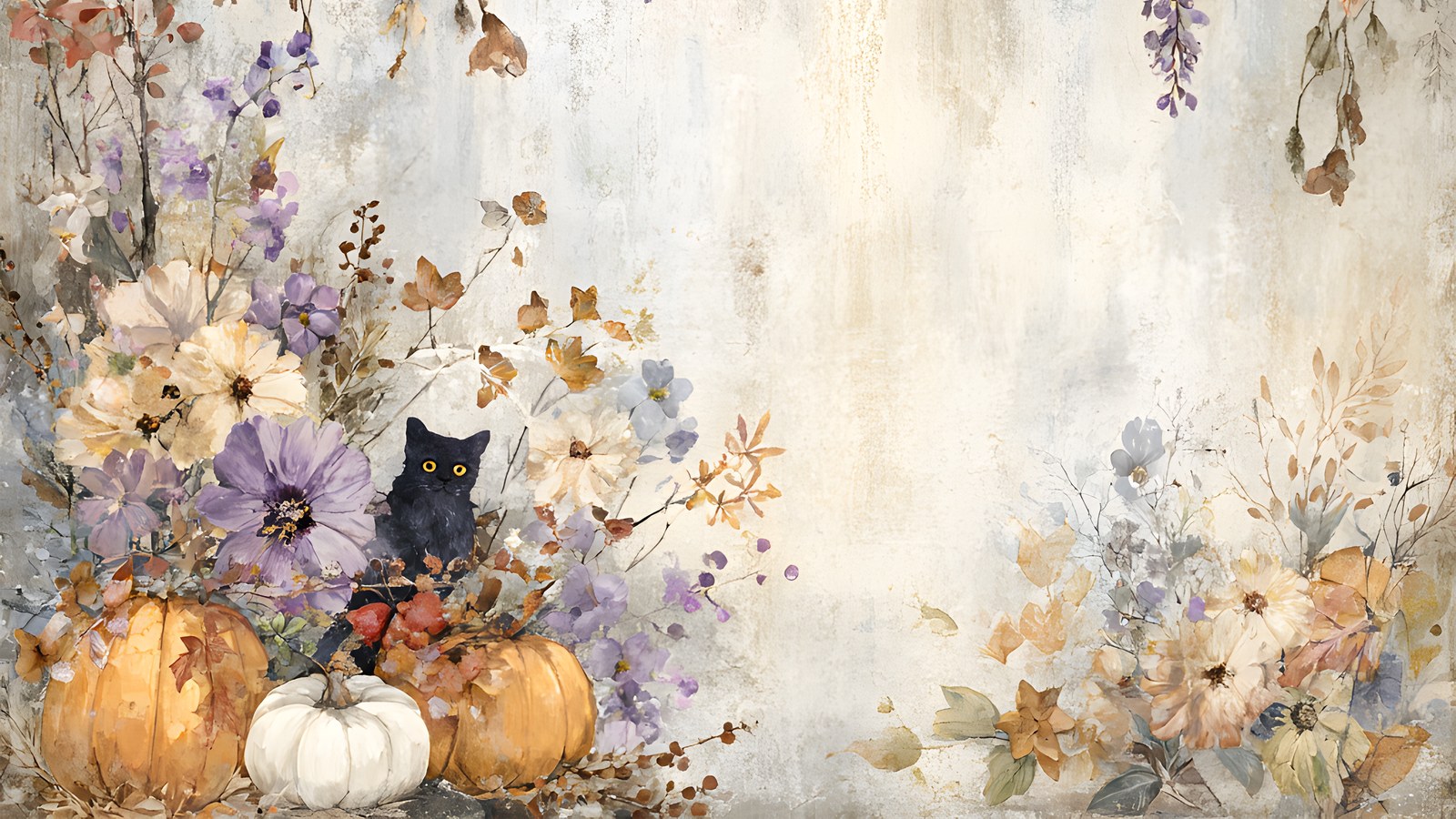
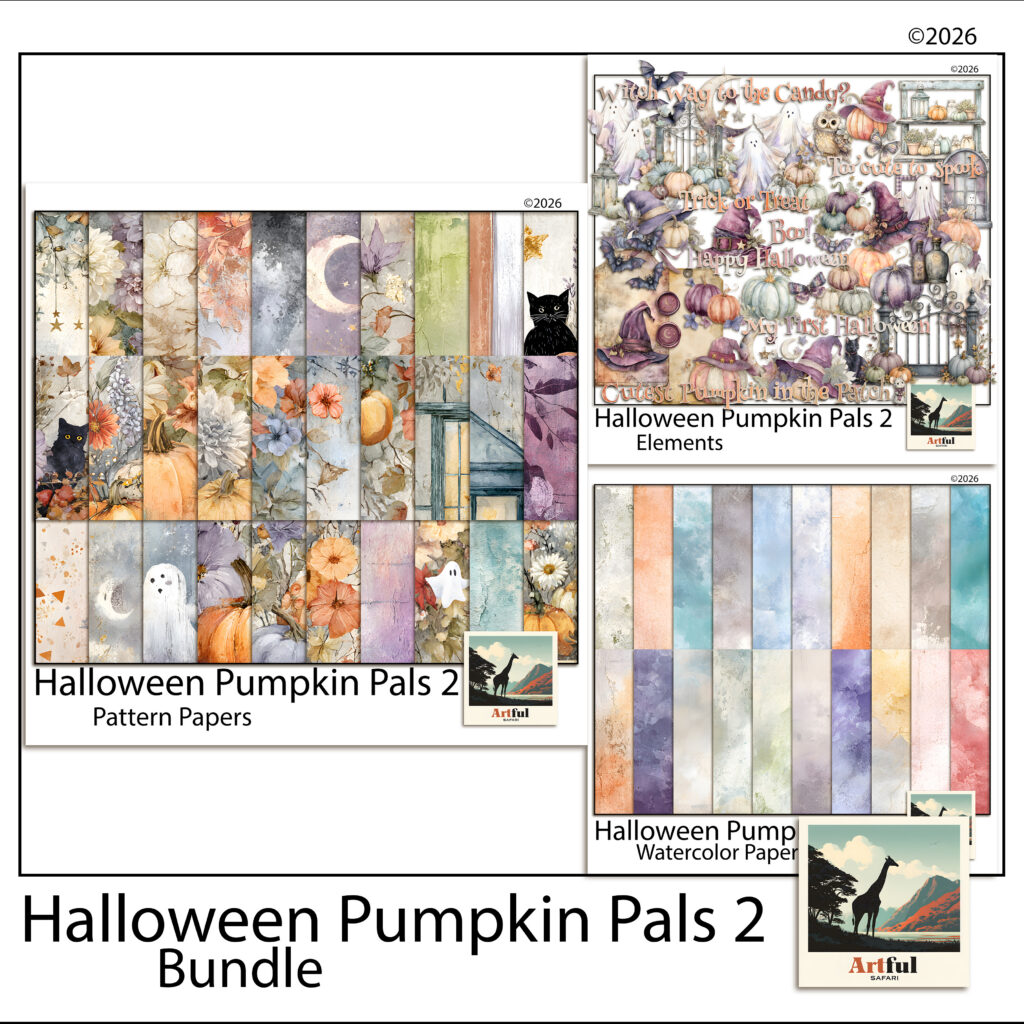
For the background, the pattern paper with lilac wisteria along the top and a black cat among the pumpkins at the bottom.
Behind the photo, a pale blue watercolour wash, trimmed a little larger than the photo and set just above centre.
The costume shot goes straight on the wash.
The iron garden gate with pumpkins sits overlapping the lower right corner of the photo.
“Too Cute to Spook” in apricot lettering goes in as the title, overlapping the top left corner of the photo.
Three purple bats fly out of the top right corner.
A small tag tucked under the gate holds the journaling, with the date and one line about the night.
That is seven steps on one page. The cat on the paper and the pumpkins at the gate carry the Halloween theme, the wash keeps the photo clear, and apricot repeats three times: in the title, in the peach pumpkins at the gate, and in the date on the tag. The page has no orange and black background, and it still reads as October from across the room.
Where to take these Halloween scrapbook ideas next
Try the plain-wash rule first, on a page you already have. Swap the patterned background for a wash behind the photo and see how much the costume comes forward. Once that works, the other six are small adjustments on top of it.
Types of journaling include diaries, gratitude notes, bullet journals, art and junk journals, commonplace books, reading journals, travel journals and prompt-led writing. Choose by what you want to put on the page: a memory, a plan, a picture, a saved idea or a story.
To try one today, use a notebook and pen. Pick a section below and make one entry. For a collage, add a paper scrap and glue. The sample pages are invented examples made for this guide, not customer journals or pages from a paid game.
If game-style journaling appeals, our solo journaling RPGs are printable games you play in your own journal.
The daily diary
A diary is a place to record your days and thoughts. Try it if you want to write about your own life. Start with the date and one thing you noticed. Add what you thought about it, if you wish. You can write about a quiet day, skip dates or return after a gap.
Tuesday · Diary sample
Rain on the walk home. I waited under the library porch and watched the water drip from my bag.
I might leave a spare bag by the door.
Invented entry: a small event, then a thought. A full account of the day is optional.
Gratitude journaling
Use this page to note something you appreciate. It could be a person, a meal, a place or a small act. Try one item and add a detail about why you chose it. There is no need to fill a fixed list for this exercise.
Tuesday · Gratitude sample
Glad of: the library porch.
Why: it gave me a dry place to wait while the rain passed.
The same imagined day, with attention on one thing appreciated.
If you keep naming the same thing, you could add a new detail or leave the entry short.
Bullet journaling
The Bullet Journal method uses short entries and symbols to mark tasks, events and notes. Its official rapid logging guide explains the symbols: a dot for a task, a circle for an event and a dash for a note. Rapid logging means writing brief entries in this form.
Try it if you want a page for things to do as well as things that happened. Here is a small sample, not a full setup for the method.
Tuesday · Short log sample
• Return library book (task) ○ Walk home in rain (event) – Bag needs to dry (note)
Invented entries with labels beside the symbols. The official guide covers task updates and copying unfinished tasks to a later list.
Art journaling and junk journaling
For an art journal page, try drawing, paint or collage, with as much text as you want. For a junk journal page, try saved scraps such as an envelope, a ticket or wrapping paper. These approaches can share a page.
Start by placing one scrap on a blank page. Leave a space beside or below it for a date and a line of writing. Move the scrap until you like the layout, then glue it down. Keep the notebook page in place.
Place a paper scrap here Example: a piece of an old envelope
Date: Tuesday
Writing space: This blue reminds me of the library door.
Layout diagram, not a photo of a finished page. The dashed box marks a scrap; the text below shows where a caption can go.
The commonplace book
Use a commonplace book to collect ideas and passages you want to keep. To try it, copy a short line from something you are reading. Add the author, title and page number, or a link for a web source. Put your own thoughts below the copied words so you can tell them apart.
A simple page could have four labels: Topic, saved line, source, my note. If you want to find entries by topic, number the pages and list those topics at the front. You can add that list later.
The reading journal
Use this to keep notes about books. You might track titles, write reviews, give ratings or record thoughts as you read. For a first entry, write the title and where you stopped. Then add one thing you noticed or a question you have.
Invented sample: “Book: The Blue Gate, a made-up title. Stopped at: chapter two. My question: why did the visitor leave the key behind?” You can return to the question on a later page. Finishing the book is optional for this exercise.
The travel or memory journal
Choose an outing, a place or an occasion you want to record. Add a date, a place name and one detail. You could include a photo or ticket, or just write a caption. Write during the trip or when you get home, as you prefer.
Invented sample: “Tuesday, library steps. We waited for the rain to ease. The blue door was propped open.” If a detail is uncertain, mark it as uncertain rather than filling the gap with a guess.
Prompt-led writing and journaling games
A prompt gives you a subject or question to write about. Try one if you want a starting point. A journaling game adds rules for play; check the chosen game’s materials and instructions before you begin. A prompt on its own does not need a game.
Prompt: A letter waits under the library door. What is written on the envelope?
Sample response: Only my street name, in green ink. I turn it over and find a sketch of the porch.
Original fictional exercise, not a scene or rule from an Artful Safari game. Write your own response and stop when you have answered the prompt.
Pick what you want to save today. For a moment from your life, try the diary or memory page. For a plan, try a short log. For paper and pictures, try the collage layout. For reading, choose a book note or a saved passage. For fiction, answer the letter prompt.
After one entry, ask whether you want to make another like it. Keep the format, change the prompt or try a different page. You can mix these ideas in the same notebook.
A journaling game gives you a prompt, usually off a card or a die, and you write down what happened to a character you made up. You keep the writing in a notebook you own. Nobody is playing against you and there is nothing to win, and the rules are short enough to learn on the first night.
That last part is the bit people do not believe until they see it. The word most of these games carry on the cover is “roleplaying”, and for a lot of us that means a table of teenagers with strange dice in the early eighties.
What actually arrives is a book of prompts. The rest is a notebook you already have.
The crafters who found this in the past two months call it an RPJ, short for role playing journal. The word was coined on camera by the YouTuber Journals4breakfast, who took one look at the four-word official name and decided it was too many words. Her video is the fastest way to understand the appeal:
Table of Contents
What actually happens in a journaling game
You draw a card, or roll a die, or turn to the next numbered page. The game reads back a situation. You write down how your character met it, and then you close the book until tomorrow.
One card, one situation, one page. In a journaling game that is the whole loop.
Some hand you the situation as a card like the one above. Others give you a table of numbered results and a die to pick one. We pulled the parts apart in the complete guide to one quiet night.
How to choose your first journaling game
Most people who abandon a journaling game abandon it after printing, not after playing. Every entry below answers the same three questions, because those are the three that decide it: what it is, what you need, and how much writing an average night asks for.
The seven below are ordered by how little stands between you and your first page. The first two ask almost nothing. The last runs for a year.
1. Alone Among the Stars
What it is: you are a lone explorer visiting planets nobody has named, and each planet gets one entry. The whole ruleset is about four pages.
What you need: a pack of playing cards, one ordinary six-sided die of the kind in a board game box, and a notebook.
How much writing: as little as a few lines per planet. Takuma Okada says a game runs from a few minutes to several hours, so this is the journaling game you can reach a real ending in tonight. It is name your own price, so the download works with the price set to nothing.
2. The Sticker Game
What it is: a story told through 41 short audio tracks, where you answer with stickers rather than sentences. Cassi Mothwin built it as an audio drama you play along with.
What you need: headphones, a notebook, and the stickers already in your drawer. The rules ask for more than twenty and then tell you not to go and buy any, which is a sentence worth reading twice.
The stash finally gets a job. Most of these ask for what you already own.
How much writing: barely any, which is the point. It runs to roughly one to two hours, making it the other journaling game here you can finish in an evening. It is $12.99 USD or more.
3. Apothecaria
What it is: you are the witch in a small village and people keep turning up with ailments. You gather things, you brew something, you write down whether it worked. Anna Blackwell describes the tone as Studio Ghibli by way of Stardew Valley.
What you need: a pack of playing cards including the jokers, a journal, and something to write with.
How much writing: a session runs about half an hour, and it is built to be played over months rather than finished. Shannon Green set hers up inside a gutted hardback and filmed it:
What it is: a journaling game set inside one endless castle, and you walk through it room by room. Nich Angell’s own words: a solo rulebook that “throws prompts and moments at you, and you must decide how your character reacts while recording your adventures in a journal”.
What you need: the rulebook, a pack of playing cards, and a blank journal.
What it is: the journaling game here that is not fantasy at all. You are a bounty hunter taking a contract in the middle of a war between six factions, and it reads like a western that happens in space.
What you need: two ordinary six-sided dice and a notebook. That is the entire kit.
How much writing: your choice, because Jason Price built two ways to play it. There is a quick mode and a slower Story Mode for people who came for the journal. It is $10 USD or more, and we have six ways to journal a bounty hunt.
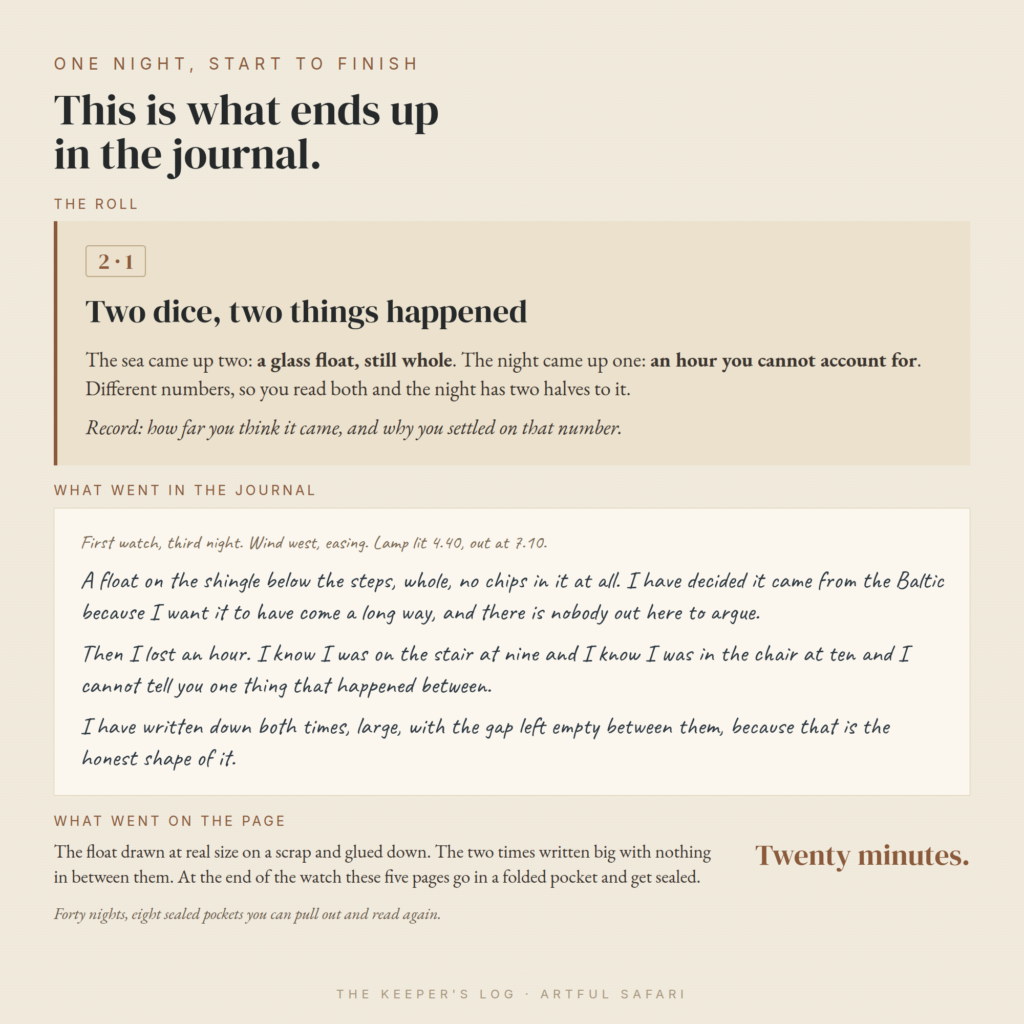
What one night of a journaling game looks like on the page
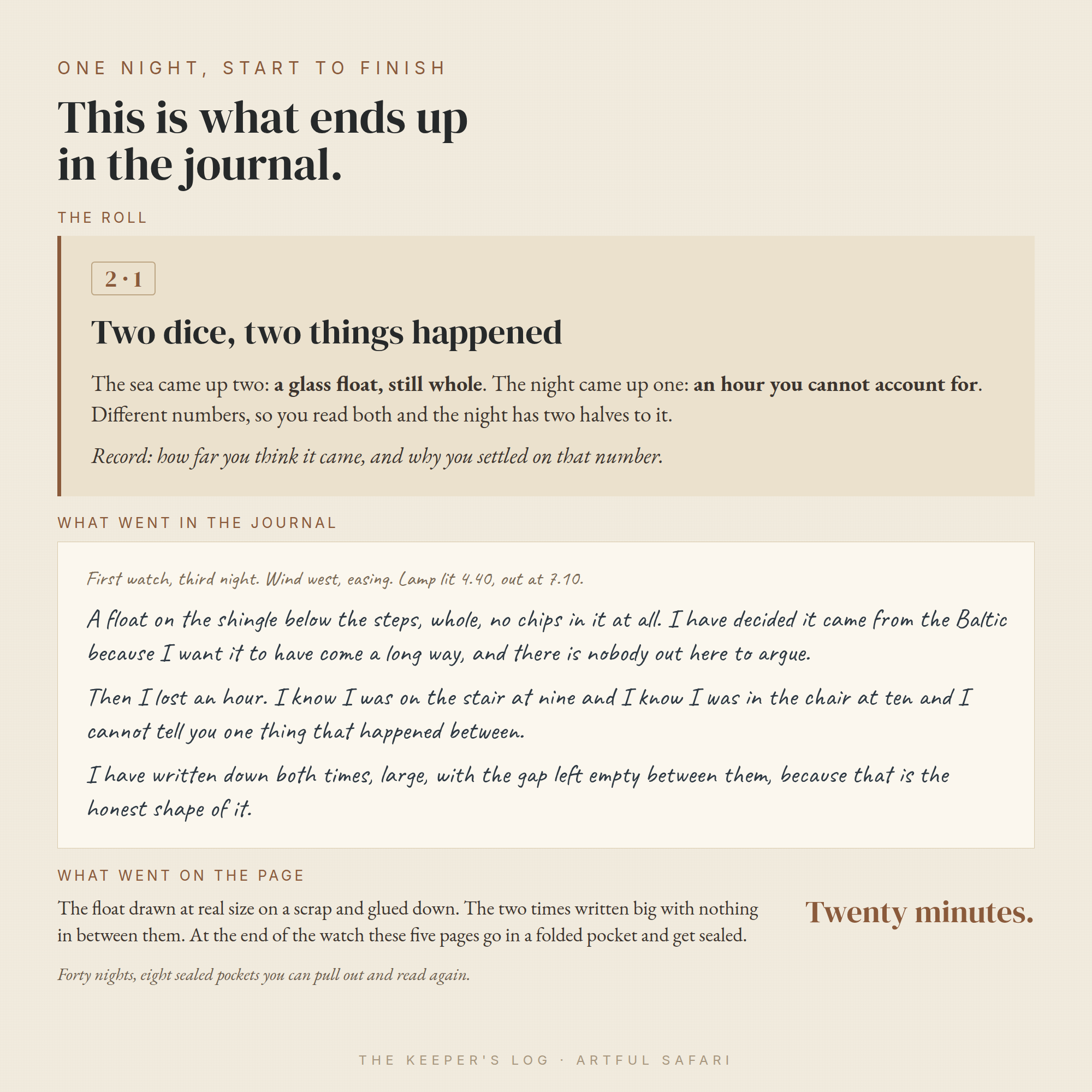
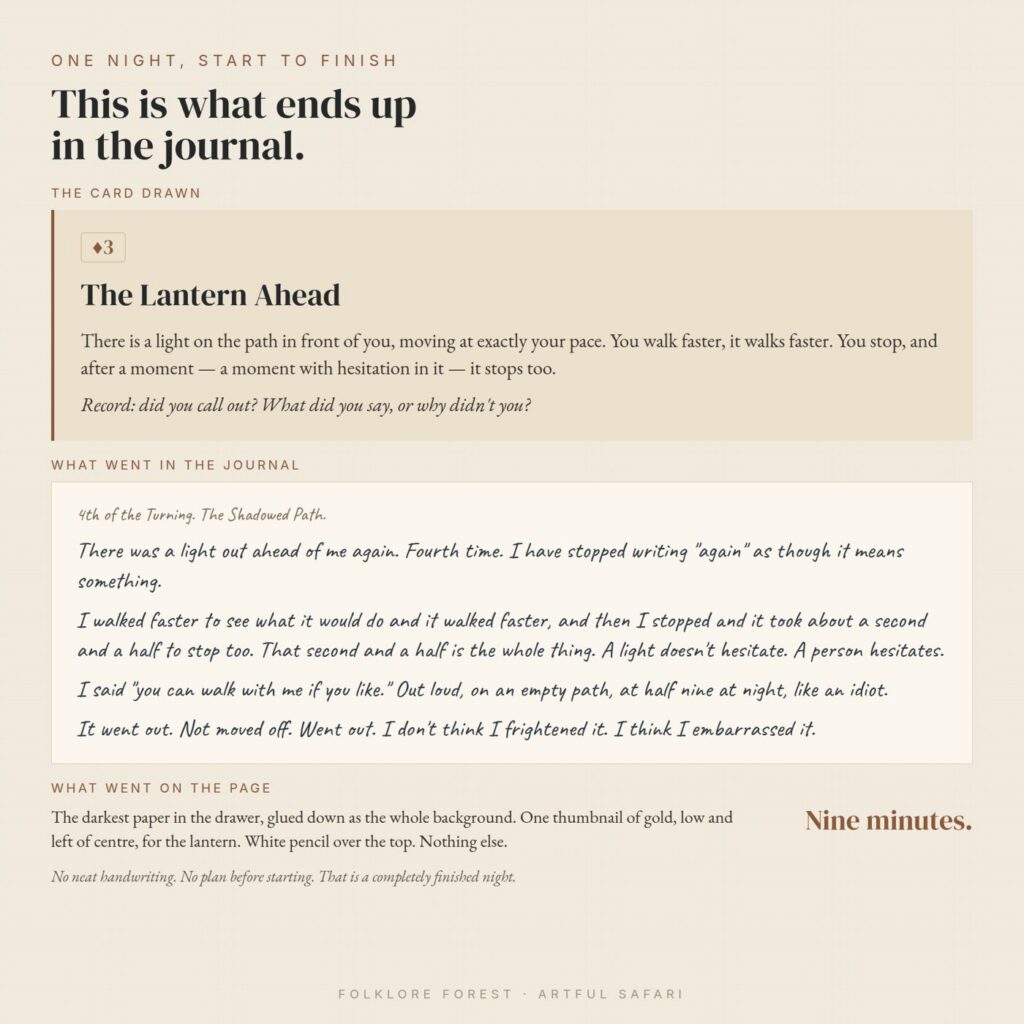
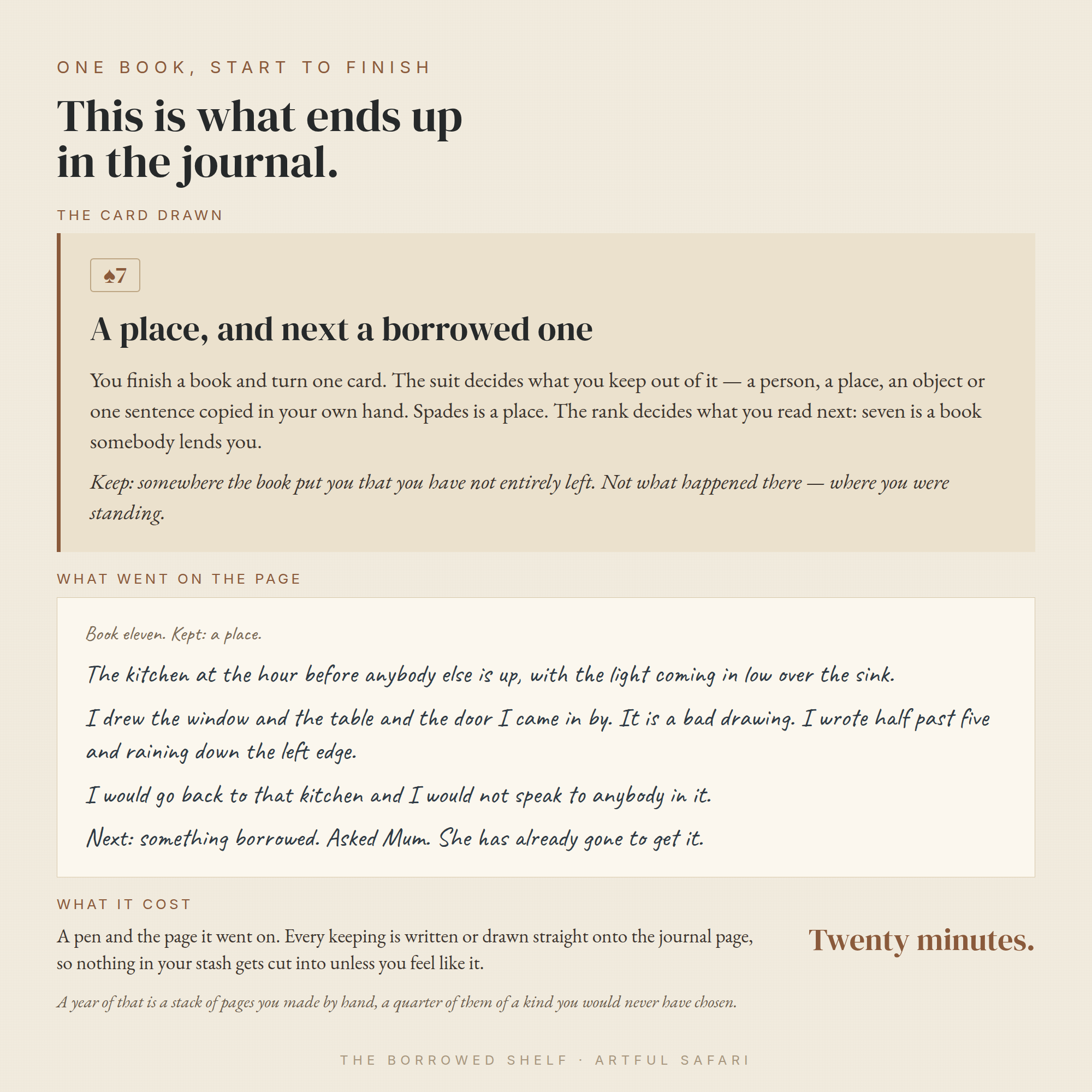
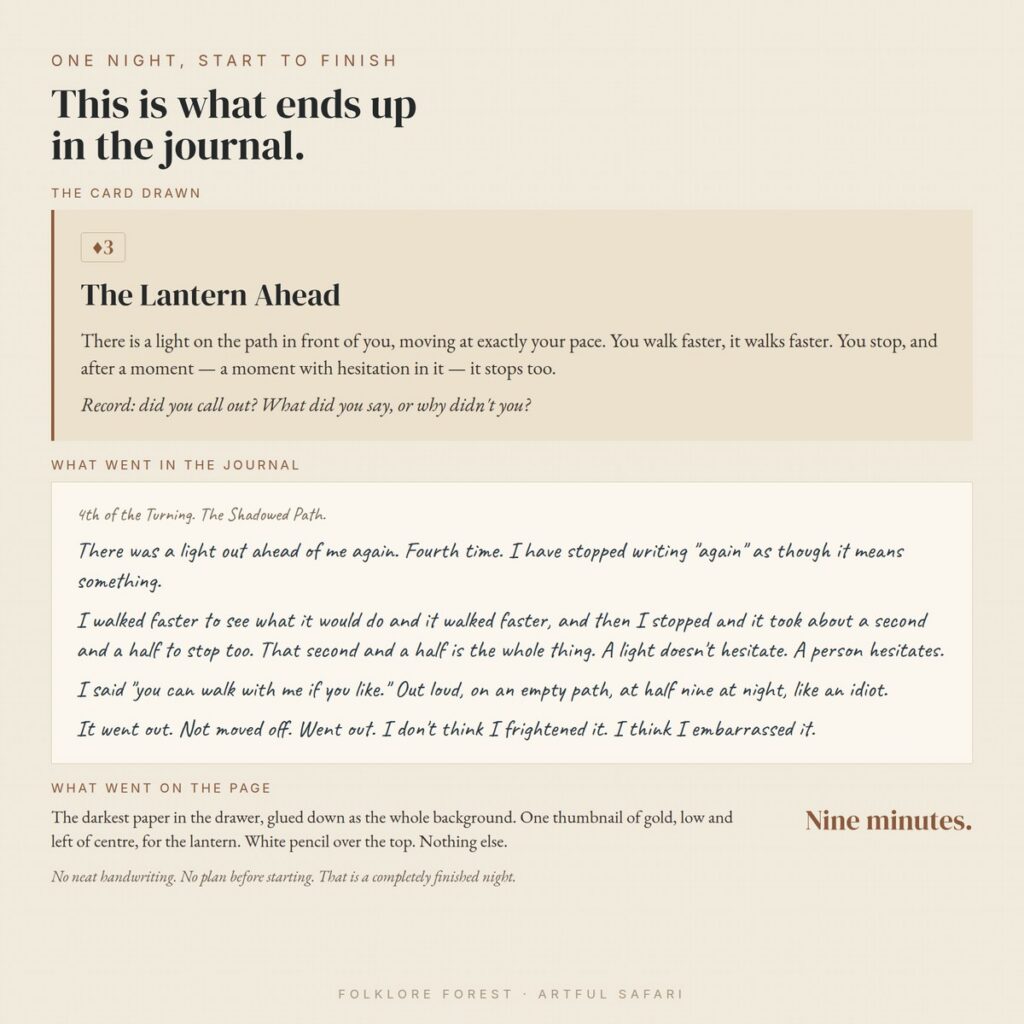
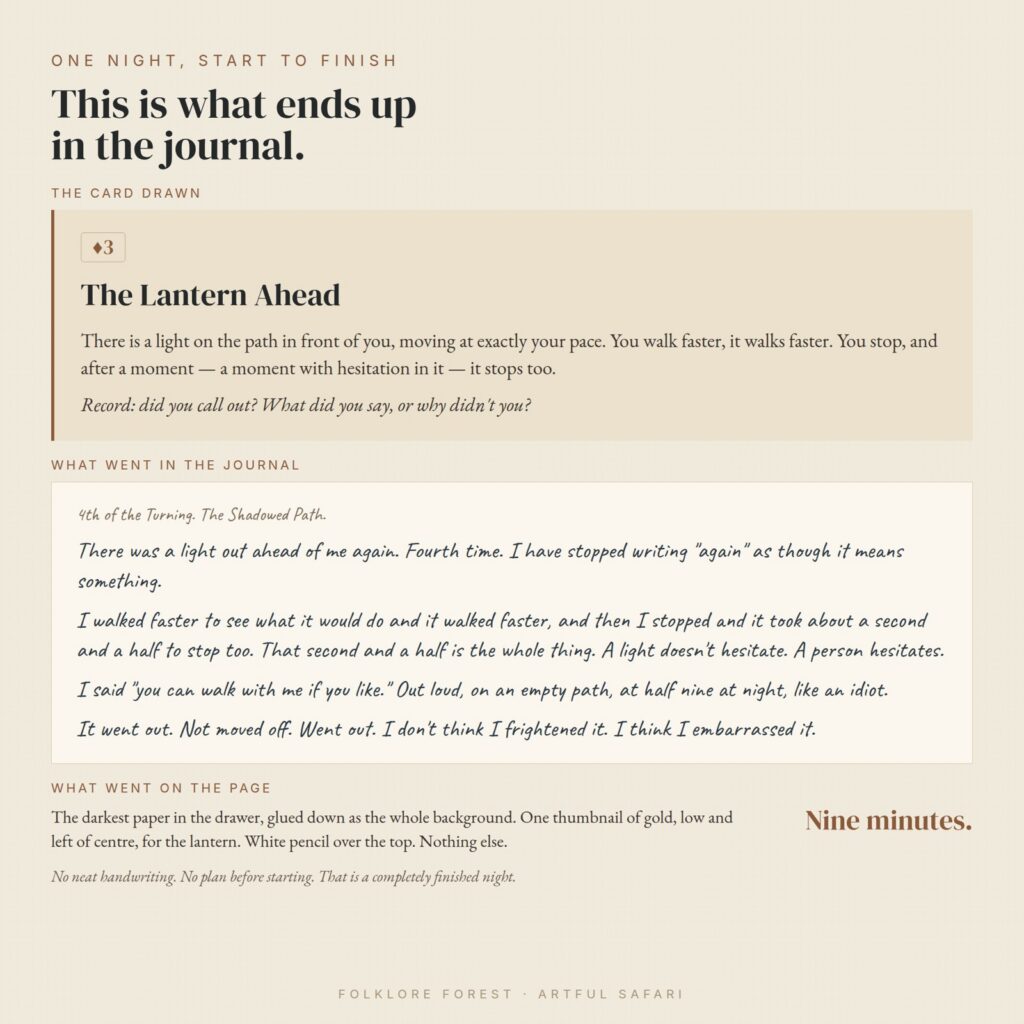
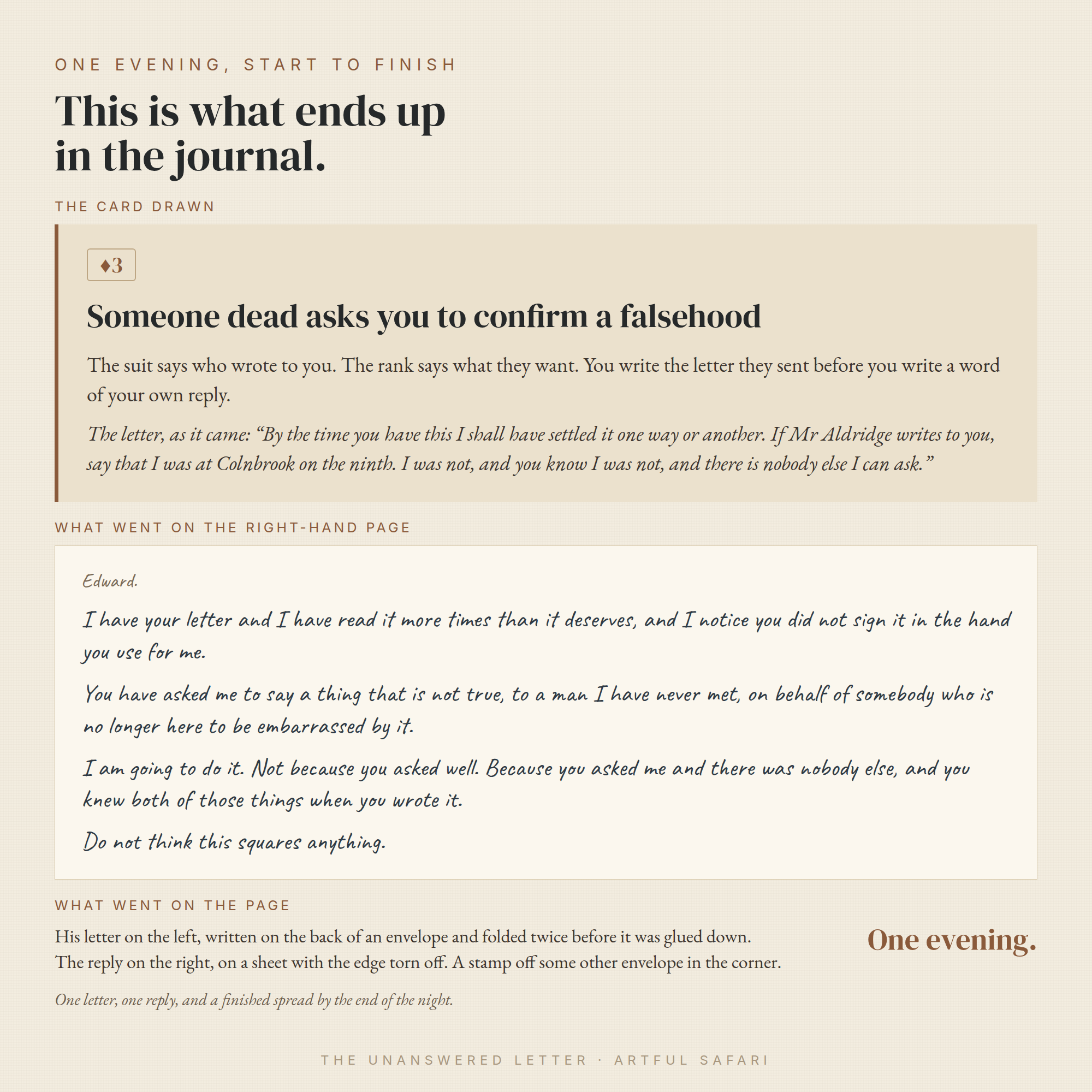
Almost nobody shows this part, which is why it stays mysterious. Here is one real night: the card that came up, and what went into the journal underneath it.
Nine minutes, in handwriting nobody would call neat. That is a finished night.
Look at what is missing. There is no essay and no plot worked out in advance, just five short paragraphs and a piece of dark paper glued down behind them.
6. Ironsworn
What it is: you swear a vow you cannot easily keep and then go and keep it, in a cold landscape of forests and violent seas. It is the heaviest book here at 270 pages, and it is free.
What you need: one ordinary six-sided die and two ten-sided ones, plus a notebook. Ten-sided dice come in any cheap dice set.
How much writing: more than the first five, because vows carry across sessions and you need a record. This is also the only journaling game here you do not have to play alone: Shawn Tomkin designed it for solo, co-op and guided play. Our six steps to a first session walks through the first vow.
7. Koriko: A Magical Year
What it is: a teenage witch spends a year away from home in an unfamiliar city. Jack Harrison wrote it as a slow year across six volumes, with a pause between each to write a letter home.
What you need: a tarot deck, some dice and a journal. It says outright that no previous experience is needed.
How much writing: the most here. Each volume takes one to two hours and a full playthrough runs six to twelve, which makes it the journaling game that genuinely fills a notebook. It is $18 USD or more, and we have five ways to keep a Koriko journal worth finishing.
Where to find a free journaling game
Two on this list cost nothing and there are dozens more. Most live on itch.io under name-your-own-price, so the download works with the price set to zero and the creator takes whatever you pay later.
The book you write in matters more than the game you write about.
Shannon Green went through twelve free ones in one video and showed how to print them so they fold into a booklet rather than a stack of loose sheets:
Wikipedia’s entry on solo role-playing games covers where all this came from, if you want the history before you spend anything.
Journaling game questions people actually ask
What is the journaling part, exactly? Am I writing like a novel, or making notes?
Either, and most people end up doing both in the same book. Plenty of entries in a journaling game are a paragraph written as the character, in first person, the way a diary reads. Others are a bulleted record you can look up in three weeks.
Is there a journaling game with less writing and more game?
Yes, and The Sticker Game is the clearest one, because you answer with stickers rather than sentences. Notorious has a faster mode built in for the same reason. As a rule the dice-driven games ask for less writing than the card-driven ones, and both ask for less than a season-and-letter game like Koriko.
Can I draw, glue and decorate in it, or does it have to be words?
Decorating is how most of this audience plays and no game forbids it. People press cuttings into Apothecaria and glue printed game pages into gutted hardbacks. If you already junk journal you are ahead of someone arriving from tabletop gaming, because the hard part for them is making the book look like anything.
Frames give a written entry somewhere to sit without you planning the page first.
Do I have to play a journaling game on my own?
No. Ironsworn runs the same rules for one player, a pair, or a group with someone moderating, and Alone Among the Stars is written for one or more players. The rest assume one person because that is what they were designed around, though nothing stops two people keeping parallel journals from the same prompts.
Is there one long enough to fill a whole notebook?
Koriko is the one here built for it, at six volumes and a whole in-game year. Apothecaria also runs long, because it is written as an ongoing village rather than a story with an ending. Either will still be going next spring.
What does a journaling game cost?
Free to about eighteen US dollars, and two on this list cost nothing at all. The very small ones sold on Etsy and itch.io tend to sit nearer five. The notebook is usually the bigger spend, and plenty of people use one that was already in a drawer.
Which one to open first
If you have never played anything, set Alone Among the Stars to nothing and write one planet tonight. If the book is the draw rather than the story, start there instead and read how to build one for a solo game, or work through your first seven nights, one at a time. Both routes end in the same place, which is an RPJ you keep.
And if a journaling game about a lighthouse keeper on a coast that keeps sending things ashore sounds like your kind of thing, The Keeper’s Log is ours: two dice, forty nights, and every rule on page two.
The best solo rpg for most people is a solo journaling game: a small book of prompts and tables you answer in a notebook of your own. Nobody else has to be free that evening. Eight of them are below, ordered from the shortest first evening to the longest, with what each one costs, what it asks you to write, and who it is wrong for.
Four things decide whether a game survives its first night on a real kitchen table. What it costs. What you have to go and find before you can start. How much writing it expects. And the kind of evening it actually produces.
Every price and every component list below comes off the publisher’s own page, read today. Where a publisher says nothing about how long a session runs, I have left the number out rather than guessed at one.
The craft side of this hobby calls these games RPJ, short for role playing journal, a word the YouTuber Journals4breakfast coined for her own channel. If you want the longer explanation of what an RPJ is before you spend anything, that is covered here.
Every best solo rpg on this list writes into a book you already own.
What you need before you pick one
A book to write in, and a pen. That is the floor for every best solo rpg here, and the book is meant to be one already sitting in your stash rather than something new.
Past that, three of them want an ordinary deck of playing cards, four want six-sided or ten-sided dice, and one wants a tarot deck alongside a stack of dice. If your book is a made one rather than a bought one, this is what a junk journal is, and this covers printing papers at home.
Before you spend anything, it is worth watching somebody turn the pages of a finished one. Andrea’s flip through of the chronicles of Alva shows what a stack of those evenings looks like as an object:
The 8 best solo rpg picks, ordered for a first evening
1. Alone Among the Stars, the smallest one here
You fly between planets and write down what you find on each one. Takuma Okada’s page asks for a standard 52-card deck, one six-sided die and a small journal, and it is name-your-own-price, so you can pay nothing.
The die tells you how many cards a planet holds; each card you turn over is a discovery, and you write a few sentences about it before turning the next. Its own listing puts an average session at a few minutes, which makes it the best solo rpg to try if you suspect you will hate the whole idea.
Wrong for you if you want a story that builds. There is no plot waiting at the end, only places. Alone Among the Stars on itch.io.
2. Last Tea Shop Classic, free and one page long
You keep a tea shop on the border between the living and the dead, and the recently deceased stop in for one last hot drink. Spring Villager asks for an hour or so of quiet time, pen and paper, one or two six-sided dice, and tea, which the page marks optional but recommended.
Dice send you a visitor and set the weather. You brew something from what is in the cupboard, ask about their life, write down what they tell you, and the game ends when a figure called the Veiled One arrives. The classic edition, in the publisher’s own words, will always remain free, which makes it the best solo rpg to hand somebody who does not want to spend a penny.
Wrong for you if death as a subject is not something you want in a journal this month. The page carries that warning itself. Last Tea Shop Classic, with a 16-page expanded edition at $5.00 or more.
Three of the eight cost nothing at all, so the best solo rpg for you may be a free one.
Shannon Green went looking for the free end of this shelf and came back with twelve of them, plus the printer settings that turn a download into a little booklet:
3. Apothecaria, the best solo rpg the crafters found first
You are the village witch of High Rannoc, mixing potions for whoever turns up at the door with Fairy Fever or Yeti Chest. Anna Blackwell asks for a deck of cards with the jokers left in, a journal, and something to write with. No dice.
It is $13.00 or more on itch, with a printed copy from her own shop, and the listing puts an average sitting at about half an hour. She describes it as a long-term game and says outright that rushing it is the worse way to play. That is why it has taken hold with people who spend a fortnight decorating a book before they answer a single prompt, and why it is the best solo rpg for a slow winter.
You are not a person in this one. You are a magical item, and you follow the hands it passes through over centuries while its keepers live and die around it.
Jack Harrison’s page at Mousehole Press puts it at $14.00 or more and calls it a great way to spend an hour sketching, world-building and storytelling in your own company. You pick from nine kinds of object, from a weapon to a deck of worn cards, then answer questions about each keeper and decide how much time passes while the item rests in the dark. If you would rather draw than plot, this is the best solo rpg on the page for you.
Wrong for you if you want to be the hero. Playing furniture is the entire point, and some people find that cold. Artefact on itch.io, with more on how it plays.
The blank first page is the part everybody stalls on.
5. Colostle, a deck of cards and no dice
The whole world is the inside of one enormous castle, and you explore it, on foot or in a giant suit of armour. Nich Angell asks for the book, a standard deck of playing cards and a notebook, and he calls it super simple and easy to play, for all ages.
Cards throw prompts and moments at you, you decide how your character reacts, and you write the result up as an adventure log. The digital edition is £12.00 and the 170-page hardback is £35.00 from his own shop, which makes it the priciest way onto this best solo rpg list if you want the paper one.
Wrong for you if you want to start tonight for nothing. It is a real book with real rules to read first. Colostle.com, and our first-journal guide.
6. Koriko, a year in six sittings
A young witch moves to a seaside city for her training year, and you write that year. Jack Harrison again: you need the book, a tarot deck and a stack of dice, plus a journal.
Cards deal you the events of the year, and when something risky happens you add a die to a tower that gets less stable as you go. It is $18.00 or more digitally, and the story runs in six volumes at an hour or two each, with every volume closing on a letter home to your witch’s mentor. As a best solo rpg to carry through a long autumn, nothing else here comes close.
Wrong for you if you do not own a tarot deck and do not want to buy one. Harrison says an ordinary deck covers most prompts, but the characters are named for the major arcana. Koriko on itch.io, and how to actually finish it.
7. Notorious, the best solo rpg pick if you want less writing
You are a bounty hunter taking a contract from one of six factions, and the job is to bring the target back. Jason Price asks for two six-sided dice and a character sheet, both supplied, and the sheet alone is a free download.
It is $10.00 or more, and it ships with two ways to play: a fast mode for people who want the chase, and a story mode for people who want to write it up. That second mode is why it keeps getting recommended to anyone who says the journaling half feels like homework.
Shawn Tomkin’s game is the one a tabletop player would recognise, and the full digital edition is free from his own site. You need one six-sided die and two ten-sided dice, and you can play it alone, with friends, or with somebody running it.
You swear a vow, then every risky action is a roll of those three dice against your character’s strengths, and the result tells you whether the story bends your way. It won a Gold ENNIE for best free game, and it is the deepest game on this best solo rpg list by a distance.
Wrong for you if you want to be writing within ten minutes. There is a lot to read first, and it is the one place on this list where a rulebook really does feel like a rulebook. Ironsworn at Tomkin Press, and our step-by-step first session.
Choosing the best solo rpg is the hard part. Playing it is easier.
Two more that get called the best solo rpg
Thousand Year Old Vampire comes up in every one of these conversations. Tim Hutchings has the digital edition at $15.00 or more, with free copies for anyone who cannot pay, and you play a vampire across centuries. The reason people talk about it is that your vampire holds five memories, so remembering one thing means losing another. It is superb and it is bleak, so it is a strange place to start.
The Wretched, by Chris Bissette, is the other one. You are the last survivor on a salvage ship, and it is played with a deck of cards, a tumbling block tower and a microphone, because you speak your log aloud rather than writing it. Wonderful, and not what most people on this page came looking for.
One evening of a best solo rpg, written up as one spread.
A page. Usually one spread with a card or a scrap stuck down and a few paragraphs in your own hand, plus a note of where you got to so the next evening has somewhere to start.
Which is the best solo rpg if I have never done this before?
The best solo rpg for a complete beginner is Alone Among the Stars, and you can pay nothing for it. It takes a few minutes, it needs only a pack of cards and one die, and by the end of it you will know whether writing to a prompt is something you enjoy. If it is, Apothecaria is the one most people move to next.
Are any of them really free?
Three of the eight are. Alone Among the Stars and Last Tea Shop Classic are name-your-own-price and you can set that to nothing, and Ironsworn’s full digital edition is free from the publisher. The other five run from $10.00 to £35.00 depending on whether you want paper.
Do I need dice, or can I use cards?
It depends on which best solo rpg you pick, and both are common. Apothecaria and Colostle use a deck of playing cards with no dice at all, Last Tea Shop and Notorious use six-sided dice, Alone Among the Stars uses both, and Koriko wants a tarot deck alongside its dice.
What if I do not want to write very much?
Then the best solo rpg for you is Notorious in its faster mode, or Alone Among the Stars, where a few sentences per card is the whole instruction. Nothing on this list checks your word count, and several people in this hobby draw far more than they write.
Is there a cosy one, and is there a creepy one?
Apothecaria and Koriko sit at the cosy end of this best solo rpg list, both witchy and slow in a way people like. Last Tea Shop is quiet but it is about dying, Notorious is dusty and violent, and The Wretched is outright horror, so there is a good spread if you want the lights on or off.
I bought one months ago and never started. What now?
Open the best solo rpg you already own at its first prompt and write three sentences tonight, badly. The most common thing in this hobby is a printed game and an empty journal, usually because the first page feels like it has to be good. It does not have to be, and the second page is always easier than the first.
Pick a best solo rpg and give it an evening
The shortest way through this page is to take a free one, use the book already sitting in your stash, and see whether you want a second evening. Whichever of the eight you land on, the writing is only half of what ends up on the page. The papers you stick down are the other half, and ours live in The Faded Conservatory.
A glue book is a book you fill by gluing paper into it, and it has nothing to do with the glue used to mend a book’s spine. Cuttings, wrapping, tickets, packaging, offcuts from other projects. No layout to plan and no photographs to hunt for, only scissors, a glue stick and a book you already own.
That is the whole craft. It asks less of you than anything else in paper crafting, and it is the thing that finally empties the cupboard you keep meaning to use.
It suits anyone who has bought paper faster than they have used it, which is most of us.
Table of Contents
What is a glue book, and why the search results are confusing
Type the words into a search box and half of what comes back is about adhesive for book repair. Those pages are answering a different question. The craft has simply borrowed a plain name.
You will see it written as one word too. Gluebook and glue book mean the same thing, and crafters use both without anybody minding. If you are following along on YouTube, searching the single-word spelling usually turns up more flip-throughs.
The definition people in the hobby actually use is loose on purpose. A glue book is any book where the pages get covered in glued-down paper, and the rules stop there. Nothing has to line up, and no page has to be finished before you turn over.
Glue book vs junk journal vs scrapbook
A scrapbook is built around photographs and the story attached to them. Pages get planned, titled and dated, and the album ends up being for other people to look at.
A junk journal is a book you make first and fill afterwards, usually with pockets, tuck spots and things you write. If that is the part you want, the beginner’s guide to junk journals walks through building one, and scrapbooking vs junk journalling sets the two side by side.
A glue book skips both jobs. You are not making the book and you are not curating memories, you are covering pages with paper you like the look of. It sits closest to collage, and its older cousin is the commonplace book, where people pasted and copied whatever was worth keeping.
What goes in a glue book
Anything flat that will take glue. Magazine pages, seed packets, tea wrappers, ticket stubs, envelope linings, stamps, packaging, till receipts, the good bits of a birthday card.
Offcuts count double. Every crafter has a bag of trimmed edges and misprints too nice to bin, and a glue book is where those stop being waste.
Here is a librarian walking through the making of one from start to finish, which is worth watching if you want to see the pace of it before you begin:
Bookmaking with Annie, Episode 3, from Nashville Public Library.
5 easy ways to start a glue book
Each of these works with a book you already have and paper already in the house. Pick one and ignore the other four until it stops being interesting.
1. Empty one drawer into it
Choose a single drawer or one bag of scraps and give yourself the rule that nothing else may be used. Glue pieces down until that container is empty, overlapping wherever two things want the same space.
The limit is what makes it work. A whole craft room is paralysing and one drawer is a decision already made for you.
One drawer emptied onto one spread. Nothing measured, nothing matching.
2. Make the whole glue book one colour
Pick a colour and only glue in things that carry it. Pink wrapping, a pink label, the pink corner of a magazine advert, a scrap of gingham.
Colour does the composing for you, so a page of unrelated rubbish still reads as deliberate. A single-colour gluebook can run for months, which suits anyone who would rather keep a collection going than finish a project.
One colour, several sources. The palette holds it together.
Ceri Griffiths spent over a year on a single-colour book and filmed the finished flip-through, which shows what the approach looks like at the end:
Ceri Griffiths, flipping through a finished one-colour book.
3. Tear the edges instead of cutting them
Tear every piece by hand and let the fibres show. A torn edge sinks into the page underneath it, where a scissor cut sits on top and announces itself.
This is the fastest way to make a glue book look like the ones you have been admiring. It also removes the last excuse about not cutting straight.
Torn edges soften where two papers meet, so mismatched scraps stop fighting.
4. Give some pages a pocket or a tag
Glue three sides of a scrap down and leave the top open, and you have a pocket. Slip a tag inside with a note on it, or a cutting you have not decided about yet.
Pockets are the point where a glue book starts holding things rather than only showing them. They are also useful when you love a piece but cannot commit it to a page.
A tag tucked into a glued-down pocket keeps a page working after it is full.
5. Add words you did not write
Cut headlines, price tags, instructions and stray sentences out of whatever is going in the recycling, and glue them in as they are. A found phrase gives a page a subject without asking you to journal.
Words someone else wrote, doing the work of a title.
Where a glue book tends to lead
A lot of people start a glue book to use things up and find out they like keeping a book. The gluing stops being the point somewhere around page twenty, and the wanting-it-to-add-up-to-something starts.
That is usually when a solo journaling game turns up. It is a small book of prompts and tables you play by yourself in a journal: you draw a card or roll a die, read what the book says has happened, and write and stick down your answer on the page. The craft side of YouTube calls it an RPJ, a name coined by the creator Journals4breakfast, and it has moved through junk journalling circles fast this year.
The reason it fits a glue book habit so neatly is that it hands you a subject each night without handing you homework. Your pages keep being made of glued paper, and now there is a story running underneath them.
One night of an RPJ, start to finish: what the book asked, and what ended up glued on the page.
The point is to use paper you already own without needing a reason. A glue book has no theme to serve, no photographs to source and nobody to show it to, so it removes every part of paper crafting that makes people stall. It becomes the book you reach for when you want to make something and have no idea what.
Do I need special glue?
No. An ordinary glue stick handles most of what goes in a glue book, and a bottle of white craft glue covers anything heavy or slippery. Avoid anything very wet on thin paper, since it wrinkles as it dries. This is a craft people run for years on supermarket supplies.
What book should I use?
Whatever is already in the house. A composition notebook, an old hardback, a diary you abandoned in February, a sketchbook that intimidated you. Thin pages cockle as the glue dries and that is normal, so glue two together when you want a sturdier surface.
How is a glue book different from a junk journal?
A junk journal is usually built by hand before it is filled, with signatures, pockets and covers made from salvaged materials. A glue book starts with a book that already exists and only concerns itself with what goes on the pages. Plenty of people keep both, and the two habits feed each other.
The first page feels daunting. Where do I actually start?
Cover the whole of one page with a single large piece of paper before you do anything clever. The blank page is what stops people, and it disappears in one move. Once there is a background down, adding a ticket or a torn strip on top stops feeling like a decision.
Can I use printed papers instead of magazine cuttings?
Yes. Cuttings run out faster than you expect, and printed papers refill the drawer with the backgrounds and the ephemera you actually want. That helps most with a one-colour glue book, where finding enough of one shade is the hard part.
Starting tonight
Pick the book, pick one drawer and cover a page. A glue book has no standard to fall short of, so the first page and the hundredth are equally correct.
And if the pages start wanting a story to hang on, the Folklore Forest kit pairs woodland papers and ephemera with a 52-night journaling game, so the paper and the prompt arrive together.
To make a junk journal for a solo journaling game, build it around the length of the game instead of the look of one page. Enough pages for a year of entries, tabs so you can find night twelve again, pockets that hold a card or a pressed leaf, and a back section you leave empty on purpose. Everything else is decoration.
That is a different brief from the books most of us already make. A themed junk journal is finished when it looks right. Make a junk journal for a game and the finish line moves to wherever the story ends, which might be forty nights away.
The crowd doing this calls the finished book an RPJ, short for roleplaying journal. The word was coined on camera by the YouTuber Journals4breakfast, who decided “solo journaling roleplaying game” was too many words and shortened it on the spot.
If you want papers that already match, and often ephemera too, our printable junk journal kits are made for this.
One night’s play. This is the unit the book has to hold, forty or so times over.
Table of Contents
Why an RPJ is built differently
The same sentence keeps turning up under craft channels on YouTube: I bought the game, I have a journal, and I still have not started. The book is usually the reason. Make a junk journal purely as an object and there is nowhere in it for the parts a game keeps asking for.
A game wants a place to write down who you are before you begin. It wants somewhere to keep the score of whatever you are tracking, be that coins, herbs or days survived. It wants to swallow a playing card without the page buckling.
So make a junk journal as four fixtures with space between them. It takes an afternoon, and almost nothing you do not already have: a blank book or a hardback you will gut, the papers in your stash, glue and scissors.
Shannon Green sets hers up inside an old chemical dictionary and films the whole build. Worth watching before you cut into your own:
How to make a junk journal for a solo game in 6 steps
Step 1: Count the nights before you make a junk journal
Open your game and find how long it runs. Most say it plainly in the first page or two, and the usual lengths are seven nights, forty nights, or a year of weeks.
Give each night a full opening rather than a single page. Forty nights becomes eighty sides, which is about a hundred-page book once you add the front matter and some spare. Doing this sum first is the one thing that stops a book running out in October.
Count the nights, double it, add ten. Make a junk journal at least that long.
Step 2: Make a junk journal out of the stash you already own
Now go and pull paper. Not new paper. The folders you bought in 2021, the offcuts you kept because they were too nice to bin, that pack of card you have moved house with twice.
Mix weights on purpose. Heavier sheets take glue, ink and a taped-down card without warping, while lighter sheets keep the book closing flat. A book that will not close is a book you stop opening.
One caution from the archivists. The Library of Congress advice on caring for paper says to keep sticky tape, rubber bands and acidic paper away from anything you want to keep, because the acid travels into whatever it is touching. For a book you will still be writing in next winter, that argues for acid-free card at the hinges and plain white PVA rather than a tape runner.
Cut-outs that have been waiting in a folder. A game finally gives them somewhere to go.
Step 3: Build the front matter the game keeps asking for
Before night one you need two fixed pages at the front. The first is your character: a name, what she does, what she wants, and a face if you have one to cut out or stamp.
The second is the place. A map, a plan of the house, a coastline, or a list of the rooms you have not opened yet. Games send you back to both of these constantly, so make a junk journal that keeps them where your thumb lands.
Step 4: Add pockets that take a card
Most of these games use ordinary playing cards or two dice to decide what happens next. Make a junk journal for one and you want somewhere to put the card you drew, rather than writing down what it was.
A folded envelope glued along three sides does it. So does a tuck spot, a library card sleeve, or a strip of paper glued at both ends. Put one on roughly every fourth opening.
Pockets and tuck spots, the fixture people forget when they make a junk journal for a game.
Step 5: Make the running record findable
Somewhere in the book you are keeping a score that changes: supplies, coins, days, the people you have met. Give it a spread of its own near the front and tab it so your thumb finds it without looking.
Ribbon, a folded strip of card, a torn tag glued to the edge, washi folded over the page. Tab the character page too. Make a junk journal without this and you will spend the first ten minutes of every night flicking.
Shannon Green tabs her book and coffee-dyes the pages in one sitting. The tabbing half is the part to copy:
Step 6: Leave the last quarter alone
Decorate the front third and stop. Leave the back plain, or bind it so you can add pages later with a few stitches or a ring.
Two things go wrong if you make a junk journal that is already finished on night one. Your story arrives somewhere you did not plan for and there is no blank paper to meet it, or the pages are so worked that writing on them feels like vandalism.
A corner done, the middle empty. That is what a page should look like before night one.
Your first night in the book
Open the game, read the first prompt, and answer it on the first opening. Write two sentences if that is what you have. Stick down whatever you drew, date the corner, shut the book.
The commonest mistake is to make a junk journal so finished and so pretty that you never play in it. A book gets better with a game running through it, not before.
The other is going shopping. Half the pleasure people describe is raiding their own stash and finally spending what has sat in the craft room for years, so buying more rather defeats it. Read two pages of the rules, play one night badly, and go back to the rules when something confuses you.
Questions people actually ask
I have the game and I have a journal. How do I actually start?
Do step three tonight and nothing else: make the character page. It takes twenty minutes, it uses the game’s own questions as your prompts, and once a character exists in the book the first night has somewhere to happen. This is where most people stall, and it is nearly always the missing front matter.
How many pages does the book need?
Two sides per night, plus about ten for front matter and spares. Make a junk journal of around twenty-five pages for a seven-night game, or ninety for a forty-night one. If your book is smaller, use the game’s short version or plan a second volume.
Do I need dice?
Usually two ordinary dice, and a deck of playing cards will stand in for them in most games. Take the ace to six out of one suit, shuffle, and draw instead of rolling. Our card games are designed for a standard 52-card deck of playing cards, and plenty of other games need nothing but a notebook and a pen.
Do I have to be a good writer?
No, and the people doing this loudest are barely writing at all. Plenty fill their books with stickers, stamps and cut-outs and put one line underneath. Nobody sees the book unless you show them, so there is no plot hole to be caught out on.
I have never played anything like this. Is a junk journal the right book for it?
It is the best book for it, because you already know how to build one. Make a junk journal and you are already building pockets, tabs and layered pages, which are exactly the fixtures a game needs. If you want a refresher first, start with what a junk journal actually is.
Can I print my own papers for it?
Yes, and it is the cheapest way to get matched papers for a themed book. Our guide to printing junk journal papers at home covers the settings and the paper weights that behave.
Where to point the finished book
Make a junk journal this way and you then need a game short enough to finish inside it. Shannon Green keeps a running list of free ones, and there are dozens more on itch.io for nothing.
If you want one already sized to the book you have just made, The Keeper’s Log runs forty nights on two dice, which is the eighty-side book this article has been describing.
A solo TTRPG is a tabletop roleplaying game you play on your own, usually by writing what happens in a journal. It needs a journal, something to shuffle or roll, and a free evening. The eight below ask the least of a first-time player, and two of them cost nothing.
If you played round a table years ago and there is nobody left to play with, this is the shelf to look at. Nothing here needs a group or somebody willing to run the game for everybody else.
Table of Contents
What a solo TTRPG actually is
TTRPG stands for tabletop roleplaying game. Add “solo” and it means one player, one book of prompts and tables, and a journal that ends up holding the story.
There is no winning and no losing. You read a prompt, decide what your character does, then write down what happened in whatever way suits you. Some people write a page; some write four lines and stick a photograph next to them.
The craft side of this hobby has its own word for it. Journals4breakfast on YouTube coined RPJ, short for role playing journal, because “solo journaling roleplaying game” was too many words to say on camera. RPJ and solo TTRPG describe the same evening from two directions.
Most of these games ask for a notebook and a pen. The rest is what you already own.
What you need for a solo TTRPG night
Every solo TTRPG on this list names its own kit, and the lists are short. A journal appears in all of them, a deck of ordinary playing cards in several, and six-sided dice in a few.
Two of the eight use something less common. Koriko asks for a tarot deck, and Ironsworn uses two ten-sided dice alongside one ordinary six-sided one.
You do not need a special journal. A composition book, a hardback you gutted, or the junk journal that has been sitting on the shelf all work, and the last one is how most of this community started.
How the eight are ordered
Easiest first. The first solo TTRPG here can be read and played in a single sitting; number eight is a 270-page book you will still be learning in a month.
For each game: what it is, what you need, how much writing it asks for, and who it fits. Where the publisher does not state a figure, I have left the figure out rather than guessed.
1. Alone Among the Stars, the smallest solo TTRPG here
Takuma Okada’s Alone Among the Stars is described by its author as “a tabletop roleplaying game about exploring space and experiencing wondrous sights”. It is listed as name-your-own-price, so you can take it for nothing.
The page says you need a standard 52-card deck and a six-sided die. The publisher’s own note on session length is “a few minutes”, which makes it the one to try if you want to know whether any of this suits you before you spend anything.
Best if you want one quiet page and then bed. It will not fill a whole journal on its own, so people chasing a long story tend to use it as a warm-up and move on.
2. Last Tea Shop Classic, a free solo TTRPG on one page
Spring Villager’s Last Tea Shop Classic puts you behind the counter of a tea shop “on the border of the living and the dead”, serving the recently deceased one last hot drink. The page states it “will always remain free”.
The kit list is printed on the page: an hour or so of quiet time, pen and paper, one or two six-sided dice, and tea, which it marks optional but recommended. Play runs until a visitor called the Veiled One arrives.
The whole game is conversation rather than adventure, and it is the shortest route into a solo TTRPG that still tells a story. A 16-page expanded edition is listed at $5.00 or more if you want the illustrated version later.
Watching one played is what makes it click for most people, so start with superbrainpanic’s playthrough above before you print anything.
3. Apothecaria, the solo TTRPG the crafters found first
BlackwellWriter’s Apothecaria is “a solo journalling RPG in which you take the role of a village witch creating potions for the unfortunate villagers, adventurers, and monsters that come to you for help”. It is listed at $13.00 or more.
You need a deck of cards with the jokers left in, a journal, and something to write with. No dice. The publisher calls it a long-term game and says it is more fun to take your time than to rush to the ending.
If your journal is already full of botanical papers and pressed leaves, the potion work gives all of it somewhere to go. Our full guide to playing Apothecaria as a junk journal goes through the setup page by page.
4. Koriko: A Magical Year, the one that says beginners are welcome
Jack Harrison’s Koriko: A Magical Year tells “the story of a teenage witch spending a year away from home in an unfamiliar city called Koriko”. Mousehole Press lists it at $18.00 or more.
You need the book, a tarot deck, a stack of dice and a journal. The story runs in six volumes, and the publisher says each volume takes an hour or two, which is the clearest time estimate any of these eight gives you.
Its own page says “you don’t need to have played a roleplaying game before”, and it is the only game here that states that outright. If you want the longer read, we have a post on keeping a Koriko journal you will actually finish.
An hour after dinner is a normal amount of play. Nobody is waiting on you to finish.
5. Colostle, the solo TTRPG with cards instead of dice
Nich Angell’s Colostle is “a solo RPG rulebook that allows you to play a single player adventure campaign through the impossible and incredible world of the Colostle”, a world that is one endless castle. The digital edition is listed at £12.00 and the hardback at £35.00.
You need the book, a standard deck of playing cards and a journal. There are no dice in it at all, which is why it turns up whenever somebody says the numbers side of gaming put them off.
Its own page calls it “super simple, super creative” and “really easy to play, for all ages”. Explorers and map-makers get more from it than people who want conversation, and we have a step-by-step on starting a Colostle explorer’s journal.
6. Notorious, for a night with more game in it
Jason Price’s Notorious has you “play to tell stories of the Nomads; notorious bounty hunters who strike fear among the scum & villainy of the universe”. It is 76 pages and listed at $10.00 or more.
You need two six-sided dice, a character sheet and a journal. It carries two ways to play, an Arcade Mode and a Story Mode, and only the second one asks you to write.
That split is the point of it. If some evenings you want to roll and see what happens rather than write, this is the one that lets you do both, and our guide to journaling a bounty hunt covers the ledger side.
Publishers rarely print a session length. Where one does, it is on this list.
7. Thousand Year Old Vampire, the famous solo TTRPG
Tim Hutchings’ Thousand Year Old Vampire is “a solo roleplaying game of loss, memory, and vampires”, 188 pages, and you chronicle centuries of one vampire’s existence from the loss of mortality to the end. The digital edition is listed at $15.00 or more.
Play is prompt-driven with simple resource tracking, and the publisher says it can happen entirely on the character sheet or become a journaling activity, with both working equally well. The stated span is “a couple of hours or a couple of weeks”.
It is the one everybody names, and it is also the darkest thing here. Someone who wants a cosy evening will get more out of numbers two to five; someone who wants a story with real weight will get it from this.
Shut Up & Sit Down’s review shows what the pages look like in play, which answers the question the description cannot.
8. Ironsworn, the free solo TTRPG closest to a tabletop game
Shawn Tomkin’s Ironsworn puts you in “the dark fantasy setting of the Ironlands” as a hero sworn to perilous quests. The 270-page digital rulebook is free from Tomkin Press, along with a rules summary and printable cards.
You need one six-sided die and two ten-sided dice. It is built for solo, co-op and guided play, so the same book works alone or with the friends you used to play with.
This is the deepest solo TTRPG on the list and the one that will feel most familiar to anyone who has played round a table. It is also the most to read, so it fits better as your second or third game than your first, and we have a six-step walkthrough of a first Ironsworn session when you get there.
Dave Thaumavore’s review walks through how the moves and the oracles work, an oracle being the table you consult when you need the game to answer a question for you.
What one night of a solo TTRPG leaves behind
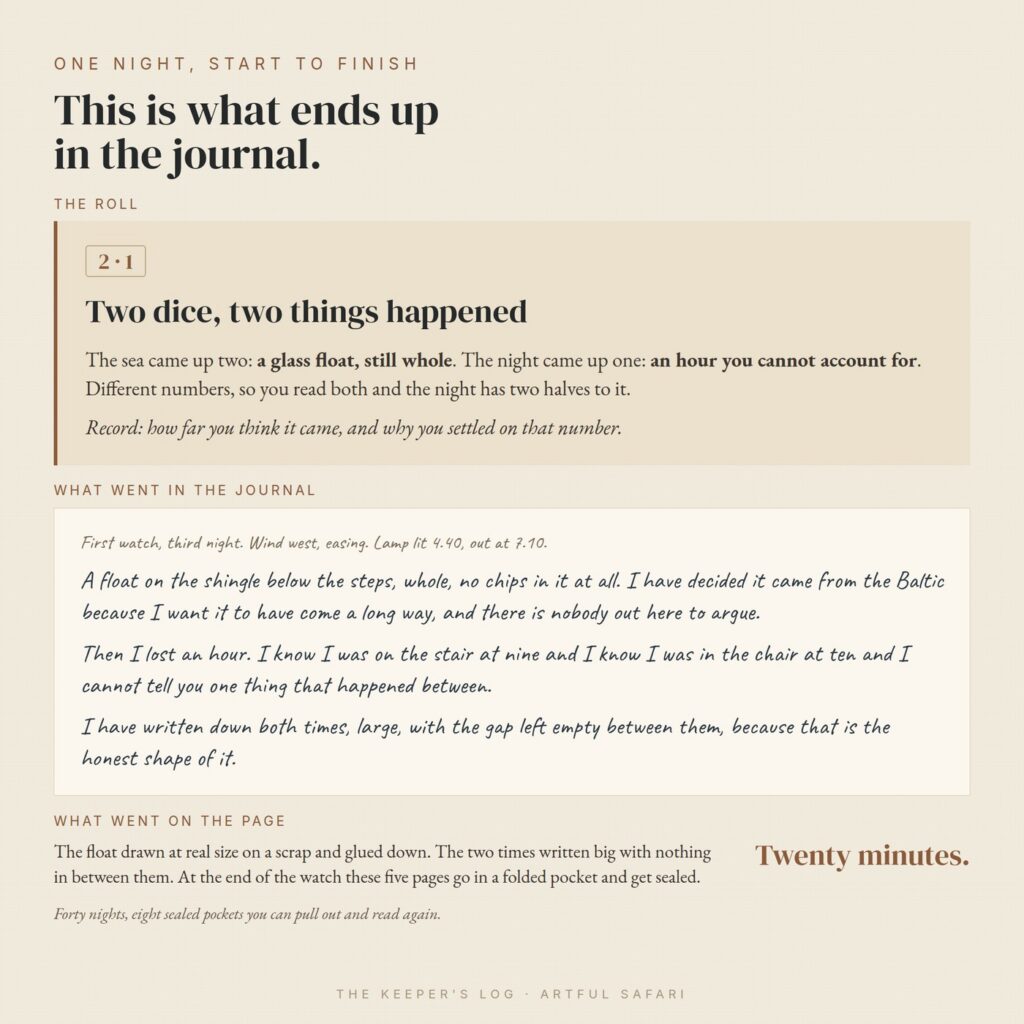
The thing nobody shows you is the page at the end. Here is one night from our own game, start to finish, so you can see the size of it.
Twenty minutes of writing, then the paper work. That is a whole night.
Twelve lines of writing and a scrap of paper stuck down. That is a full evening in most of these games. The book fills up at that rate without the evening ever turning into homework.
A blank tag is the easiest thing to add to a page you have already written.
Solo TTRPG questions people keep asking
What is a solo TTRPG in plain words?
It is a book of prompts and tables you play by yourself, writing the results in a journal. TTRPG is short for tabletop roleplaying game, the kind played round a table with dice rather than on a screen. The solo version cuts the table down to one person, which is why the journal does the work the other players used to do.
Do I need dice to play?
Not always. Apothecaria and Colostle use a deck of ordinary playing cards instead, Koriko uses tarot cards, and several of the free games ask for nothing beyond a notebook and a pen. Where dice do appear it is usually one or two ordinary six-sided ones, the kind already in a board game box in the cupboard.
Do I have to be any good at writing?
No, and nobody else is going to read it. There is no plot hole for anyone to find and no handwriting to be marked. Plenty of people answer a prompt in four lines and spend the rest of the evening on the page itself, which counts exactly the same as three paragraphs.
I bought one and still have not started. Where do I begin?
Print the first two pages only, and answer the first prompt tonight. The usual sticking point is trying to set the whole journal up before play starts, which turns a game into a project. Our seven-night starter guide walks through the first week one evening at a time.
Which one should I pick if I have never played?
Take Alone Among the Stars or Last Tea Shop Classic as your first solo TTRPG, because both cost nothing and you will know within an evening whether the format suits you. If it does, Koriko is the one whose publisher says outright that no previous experience is needed. Our wider solo RPG starter guide covers the same ground for the non-tabletop crowd.
Can I use my junk journal for this?
Yes, and a junk journal is where most of this community keeps a solo TTRPG. It already has the pockets and tuck spots where the cards and the loose scraps end up living. Our complete guide to one quiet night covers the setup if your book is still empty.
Pick a solo TTRPG and start tonight
The cheapest way in is a free game, an hour after dinner, and the journal already on your shelf. Every one of these was built for a person sitting on their own.
If you want the papers and ephemera to go with the writing, The Crimson Parlour kit carries a thirteen-night mystery of its own.
Artefact is a solo journaling RPG by Jack Harrison, published by Mousehole Press. You play the magical item rather than a person: a sword, a pair of boots, passing through the hands of one Keeper after another across centuries, while the journal you write becomes the object’s own memory.
That is the game, not the ordinary English word that happens to share its spelling. The swap is why Artefact suits a made book better than almost anything else in the hobby, since the object outlives everyone who ever holds it.
Five ways below to make the book carry that instead of just describing it.
Table of Contents
What Artefact actually asks you to do
Echoes of Time. The book has to look like something that has already been through a few hundred years.
You begin by choosing what kind of Artefact you are. The list runs to nine: The Weapon, The Shield, The Instrument, The Ornament, The Deck, The Footwear, The Staff, The Tome and The Automaton.
Each type opens with a question written for it alone. The Weapon starts at the forge that made it, and the smith who swung the hammer. You answer it, sketch yourself, and take your starting traits from a list or write your own.
Then the Keepers arrive. A Keeper gets a name and a few details, two prompts about how they used you, and one memorable event with an outcome.
Good outcome or bad, you take a Change from the matching list, so the object comes out of it altered either way. Then you work out the circumstances that lost you.
The Keepers arrive in three eras. The object is newly forged in the first, passes through a time of glory in the second, and reaches ruin in the third.
Between Keepers the game makes you sit with the passing of time. You pick how long the gap is, and the longer the gap the longer you stay in silence before writing again.
A month is twenty seconds. A century is two minutes. A millennium is four.
A long stretch of neglect also pulls a prompt for what the years did, so the world around the object either holds steady or decays.
The publisher’s own page calls it “a story game for one player, designed for contemplative solo play” and puts about an hour on a sitting.
If you would rather see the book before you buy it, Dave Thaumavore turns the pages on camera and shows how one Keeper section is laid out:
The craft side of this hobby has started calling these games RPJs, short for role playing journals. Of all the RPJs going around at the moment, Artefact is the one that pays back the most for treating the journal as the real object.
1. Build the book as the Artefact’s own record
Most journaling games leave you writing as a person, so a diary layout fits them. This one does not, because the book is the object.
The first spread is the making, not a title page about you. Whatever you answered to that opening question goes down in full, with your sketch of yourself beside it and the whole opening given over to the forge or the workshop.
One small decision changes how the entire book reads: date the spreads by the object’s reckoning rather than ours. “Third winter after the forge” carries more than “1482” when nobody has told the object what year it is.
Hold the voice to that as well. An object cannot know what happened in the next room, and a book that never breaks the rule is much stranger to read back.
2. Give every Keeper their own spread
One Keeper, one opening, and the layout identical across all of them so the differences do the talking. Same panel for the Keeper’s name, same corner for the memorable event, every time.
Let the papers follow the three eras Artefact already set up. The first Keeper’s spread can run light and clean, the second heavy with pattern and gilt, the last torn back to something plainer and darker.
First Keeper. Light, clean, barely marked, because nothing has happened to the object yet.The time of glory. Same warmth, far more of it, and the paper starts carrying pattern.
Someone flipping the book should feel the centuries turn before they read a word. A screen cannot do that.
3. Age the paper between the eras
The silence between Keepers is the best thing in the game and the easiest to lose in a journal, because nothing happens on the page. Give it a spread anyway.
Leave it empty apart from one line saying how long passed, then treat the spread physically. Tea-stain it, or glue in something that has visibly survived a long time.
The rest spread. Nothing written on it but a length of time, and the paper doing the rest.
Let the prompt decide how far you go. A decay prompt should show the damage on the paper itself, while a prompt about the changing world outside stays intact and puts the shift beyond the object.
This is where a scrap box earns its keep. Anything already stained, torn or foxed belongs in the rest spreads, because that is the only part of the book where wear counts as content rather than as a mistake.
4. Keep the Changes where you can flip back to them
The Changes are the object’s whole arc, and they disappear if they only exist inside the paragraph where they happened. Build a running record for them near the front of the book.
A tabbed page does it. Write the starting traits with room underneath each one, then strike a trait out rather than rubbing it away when it is replaced, so the object’s history stays readable on a single page.
Put the sketches there too. Redraw the Artefact after each Keeper, smaller, in a row across the bottom, and by the end the whole life of the thing sits in one line of drawings.
What a finished Artefact spread looks like
Left page is the Keeper. Name at the top, a portrait or something standing in for one, and the two prompt answers written as the object watching them rather than as a biography.
Right page is what they did with you. The memorable event takes the largest block of writing on the spread, the Change sits underneath it in a different colour, and the loss is one line at the foot of the page.
Everything else is texture. Ledger paper behind the writing, a strip of something ruined down the gutter where two eras meet.
One spread, one Keeper, one loss. Every opening in an Artefact book is built the same way so the ageing does the work.
A finished Artefact book should read like an archive somebody else kept and you found. The game says that is what the book is.
5. End the book the way the Artefact ends
Every Keeper loses you, and the last loss ends the Artefact’s story. It deserves better than a paragraph tucked into the bottom of a spread.
The last page wants one image and a lot of empty paper around it.
Close with a final page holding nothing but the object. Buried, sunk, melted down, or shelved in a collection where nobody left alive knows what it is.
One image and one line will do it. Some players seal that last page shut along the edge; others glue an envelope inside the back cover, put the object’s final trait in it, and leave whoever reads the book to decide whether to open it.
Papers that can carry several centuries
The supply problem this game creates is an odd one. A single Artefact book has to cover several eras and still look like the life of one object, and buying a separate kit per era is exactly how a book stops holding together.
One set with range inside it works better. A lighter stock for the first Keeper, the same palette pushed darker and heavier by the last, so the book ages instead of changing character halfway through.
Helene designs the Artful Safari sets to stay inside one palette family for that reason. If you are printing at home, our guide to printing junk journal papers at home covers the settings that stop a dark era page going muddy, and if the made-book side of this is new, read what a junk journal actually is before you cut anything.
Artefact questions people actually ask
Do I need dice to play Artefact?
No dice are needed to work through the book. The publisher describes the game as drawing and some writing, and play runs on questions you answer and lists you pick a Change from rather than on rolls. If you would rather have the choice taken out of your hands, the download includes a Keeper generator that throws up random Keepers for you.
Do I have to be good at writing?
No. The prompts do the heavy lifting, and plenty of people in this hobby answer them in a line or two and spend the rest of the evening on the page itself with stamps, tape and paper. Nobody reads the book but you, so nobody is going to find a plot hole in it or ask you to defend a draft.
How long does a game of Artefact take?
The publisher puts about an hour on a sitting. A book runs through a run of Keepers rather than one, so most people spread it over a few evenings, and the game carries on until the object has had its last Keeper.
I bought it and I still have not started. Where do I actually begin?
Start with the opening question for your item type and nothing else. That single answer, written out in full on the first spread with a sketch beside it, is a whole session’s work and it puts the object on the page. The stall almost always comes from trying to set up the entire journal before the first word goes down.
What is an RPJ?
RPJ is short for role playing journal, the name this crafting community gave to solo journaling games played inside a handmade book. It was coined on camera in July 2026 by the YouTuber Journals4breakfast and picked up within weeks by other makers. Artefact fits the word particularly well, since the finished journal is meant to be the object.
Do I need a special notebook, or will any journal do?
Any book with paper heavy enough to take a bit of wet work will do, and a fair few players gut an old hardback and build inside that instead. What matters more is that the paper can be aged, because the passing of centuries between Keepers is the part of Artefact that only shows up in the paper itself.
If you have never played an RPJ before
Artefact is not a difficult game, but it is a long one. A run of Keepers across centuries is a real commitment, and the same complaint keeps turning up under every beginner video: people buy the game, set up a journal, and stall before the first Keeper.
Two things fix that. Watching somebody play one through is what most newcomers say made it click, and starting on a game you can finish in a sitting gets the format out of the way before you commit to a millennium.